How to recover from business failure when you want nothing
It's 2012, I'm twenty-four, and I've been lying in bed for six months. Not the polite version where you're "in a slump but still getting a few things done" — I mean lying down: get up to eat, get up for errands, lie back down. And the whole time one thought runs on a loop, I remember the exact words: I have to build something, I have to.
Let me answer first, because I spent six months on my back looking for this answer. To recover from business failure, five things work, and the order matters:
- Open a calendar and count how many days you've been down. That's the one number you control, and it matters more than the amount you lost.
- Answer honestly: if your money ran out tomorrow, would you get up? If yes, you're not recovering, you're spending down a cushion.
- Put your debts on a payment calendar, line up the conversations about restructuring, and then close the topic. The debt has to be repaid, but it gives you deadlines, never energy.
- Write down one goal you actually want, sized at roughly three times your current monthly income.
- List your last two failures and find what was identical in your decision. Not in the circumstances — those are always different.
Why this and not "pull yourself together and start paying people back" — that's the rest of this article, and I'll start with the number that breaks the favorite consolation of everyone who has crashed: an entrepreneur who failed has a twenty-three percent chance of success in the next venture, against twenty-two percent for someone who has never tried anything. One percentage point.
Over twenty years in business I've collected three failures: 2012, 2014, and 2017, the expensive one, minus four hundred and eighty-seven thousand dollars. I climbed out three times, each time differently, and one of those times I climbed out in a way I'm not proud of.
Failure isn't a university, it's the tuition bill
Gompers, Kovner, Lerner and Scharfstein at Harvard looked at what happens to entrepreneurs on their second attempt and published it in the Journal of Financial Economics. Founders with a prior success had a thirty-four percent chance of succeeding next time. Founders with a prior failure: twenty-three. First-time founders who had never run anything: twenty-two.
Twenty-three against twenty-two. One percentage point, and that's the entire wisdom failure hands you on its own. Success experience is worth twelve points, failure experience is worth one. German researchers who went through around eighty-four hundred startups found something even less flattering: founders coming off a failure died more often than people walking in off the street.
Let me be straight about what these numbers do NOT prove, because I'm about to argue for doing the postmortem, and propping myself up with someone else's chart would be cheating. Gompers never measured whether anyone analyzed their mistakes. He measured the bare fact of failure. So the study doesn't confirm that the postmortem helps — it kills the opposite claim, that falling teaches you all by itself, with no participation from you. That twenty-three percent contains both the founder who spent three years thinking about his decision and the one who walked into a new market the next morning with the same team and the same setup.
I believed the romantic version for a long time: failure is a university. Turns out failure is the tuition bill. It doesn't teach you anything — what teaches you is what you do in the six months after, and almost nobody writes about those six months, because there's nothing pretty to write.
Your business failed: what to do when no idea sounds good
First, how I ended up in that bed, because everything else follows from it.
By 2012 I'd decided to exit both of my businesses at once. The first I expected to sell for ninety thousand dollars, the second was going for forty-five, and after everything settled I expected to walk away with a hundred thousand plus in hand. I had never held that kind of money, and I thought about it in terms of status: I'm walking out of here a rich man. Six years in the game, since 2006, and here's the moment you finally stand up straight.
On the second business I got taken. The guys buying it for forty-five thousand paid me five up front, then transferred the business into their own names and pushed me out. The mechanics are painfully simple: I signed it over holding nine percent of the money, and once the paperwork was theirs, there was nothing left to discuss. I put that deal together myself, so it's my failure, not their treachery — the treachery just found an open door.
The hit dragged in twenty-five thousand dollars belonging to my business partner in a different venture, a man who had nothing to do with any of it. I decided that since it happened on my deal, it was my responsibility, and I paid him back in full, when I could have paid half and pointed at circumstances. For years I considered that the best decision I made that year. These days I ask a second question too: did I also buy myself the right to lie down for six months afterward, with the clean conscience of a man who did the right thing and therefore owes nothing more?
To pay him fast I needed money fast, so I gave ground on the first deal: sold for seventy-five instead of ninety, because I needed it today, not in two months at a good price.
Eighty thousand came in, seventy-nine went out: forty of it to Alexander, the investor who once handed me money for my very first business without so much as an IOU and got it back with interest, and the rest to the partner, the broker, and a used car.
A thousand dollars was left.
I expected a hundred and ten thousand and walked out with one thousand and a secondhand car. And notice: I didn't go bust. No warehouse burned down, no recession wiped me out, there was no operating loss. I sold two businesses and ended up with nothing, and for your head that's worse than an honest bankruptcy, because in an honest bankruptcy you have an enemy — the market, a partner, the country, circumstances. Here there's no enemy. There's you, your signature on a deal, and your own decision to cover somebody else's obligations down to the last dollar.
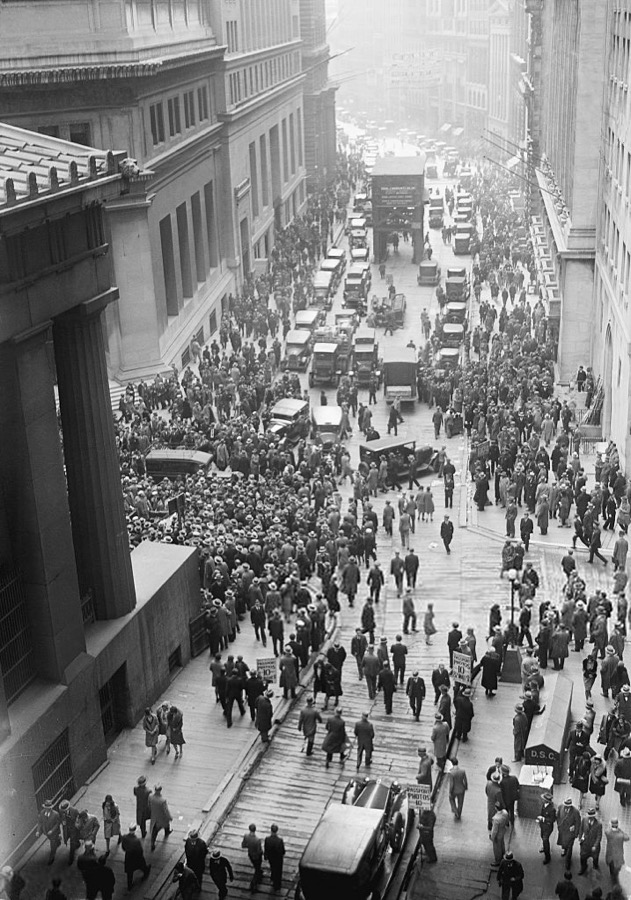 NEW YORK · 1929
Then came the six months. Whatever idea I came up with, whatever floated in, it held no interest: maybe do this — can't; trade grain — don't want to; and whatever came into my head, I stayed in bed, wanting nothing.
Then I got up, and for a long time I figured I got up because I'd handled it, because character, because something clicked inside, which is how people describe it. Until one day I lined up two dates and saw it: I got up the same month the money from the sale ran out. Maybe a coincidence, I still don't know for sure. But I felt equally bad for all six of those months, and I stood up exactly when the account hit bottom, and I've read it the same way ever since: the length of my depression equaled the balance of my cushion.
I wasn't down because I felt bad. I stayed down exactly as long as I had money.
Which is why the first honest question after a failure isn't "why did I fall," it's "how long am I planning to stay here." The first one looks backward and is easy to answer, there's always somebody to blame. The second looks forward and is a pain to answer, because you'll have to act on it. I wrote separately about what it looks like from the inside when it isn't the business that's broken but the person.
Why you have no energy after a business failure: debt doesn't produce it
Four years after that winter, at a business breakfast in Kryvyi Rih, a guy in the audience asked me:
— I know in theory that nine out of ten of my ventures will fail. I've read it, I agree with it. The question is where I get the energy to take the action anyway, knowing failure number twenty is coming eventually.
That's when I first said out loud something I had only lived through. I told him: look, any failure takes your energy, we're not robots or gods who can say "eh, only half a million down" and walk on. It rattles you regardless. So the first thing you'll run into is a skill, and the skill is measured by how long you stay in that state. Not "how do I avoid falling," not "how do I avoid being upset," but how long you lie there.
Then I told him the second thing, the one I've repeated most often since, because it breaks the picture people carry. Energy for "paying off the debt" never shows up. You're in trouble, you urgently need to return ten thousand, fifty thousand, half a million dollars. The thought of returning it will not, by itself, give you energy for a push. You'll still wake up flattened, you'll still be living off necessity. The energy arrives the moment somebody calls and says "I need it tomorrow," and then for two hours you're extremely effective, you really work. And that's how you live, from one shrinking deadline to the next, flat on your back in between. In 2012 there was nobody to call me — I'd closed every obligation immediately — so I didn't even get those two hours.
From that comes a practical conclusion that saves months. The debt has to be repaid, but it can't be the goal, because a goal pulls you forward while debt shoves you from behind in short bursts of panic. Something else has to pull, and you'll have to choose that something yourself, in a state where choosing is the last thing you feel like doing.
Depression after losing a business, or why suffering is so convenient
This is where people push back, and fairly. They say: hold on, what you're describing isn't laziness or strategy, it's depression, it runs on its own clock and willpower doesn't touch it. That's true, and I won't pretend my story covers every case. So let me separate two things right away, because after this I'm going to be fairly blunt.
Bed is a decision when you can get up for something you actually need: a client with money calls and you sit down and work; if the money ran out tomorrow you'd be on your feet; you eat, you sleep, you answer people, you simply don't want to start anything. Bed is not a decision when the state holds for months without a break, when sleep and appetite are broken, when everything that used to give you pleasure outside of work is gone, and especially when thoughts show up that it would be fine not to wake up. That isn't "pull yourself together," that's a doctor, and the only right advice is to see a specialist first and deal with everything else after. I'm talking about the first situation. I spent six months in it.
Here's how it works. Every defeat contains an element that matters to the psyche — the suffering itself — and it pays out generously. The simplest example has nothing to do with money: ever had a moment in a relationship where you know it's time to make up, but you can see on the other person's face that they haven't fully gotten it yet, so you hold the line a little longer, keep the suffering at the right level, keep the fight going when there's zero point left in it, because they haven't been punished enough? That's the right to suffer. We don't move to solve the problem, because solving it means giving up that right. As if we haven't finished suffering, haven't finished crying, haven't finished grieving.
After a business failure this runs ten times stronger, because the suffering looks appropriate. You really were cheated. You really did lose. Nobody in the world will walk up and say "all right, that's enough" — on the contrary, everyone will sympathize, and that's the dangerous part. I spent six months in a state of complete social legitimacy. I had permission to lie there, signed by circumstances.
Psychologists have measured this from the other side. There's a method called behavioral activation, used in depression treatment, and its whole logic runs opposite to the familiar one: action first, mood second, rather than "want it first, then do it." In a German trial with three hundred and seventy-five patients it worked as well as classic cognitive behavioral therapy. Nobody talks the patient into wanting something; they help him start moving, and the wanting catches up. I learned about the method much later, but when I read it, I recognized my winter: I spent six months honestly waiting to feel like it, and it never once arrived. The same mechanism runs underneath burnout, except there the cushion isn't money, it's nerve.
How to recover from business failure: five steps
This isn't motivation. It's a sequence I assembled out of three of my own holes. The order can't be changed; each step fails without the one before it.
- Measure the length, not the depth. Get up, open a calendar, find the date it happened, and write the number of days on paper. Not "how bad do I feel," but how many days. It's the one number you control: the depth of the hole is no longer up to you, the length is entirely up to you.
- Check whether your depression is financial. Honest question: if the money ran out tomorrow, would you get up? If yes, you're not resting and you're not recovering, you're spending down a cushion. Mine was sized for exactly six months, and my grief lasted exactly six months.
- Take the debt out of the goal slot. You have to repay it, and the payment calendar and the restructuring conversations belong in week one, but that's not what should be pulling you. Debt gives you deadlines and two hours of panic before a call, and you can't build a life on those two hours.
- Write a goal ahead of you, sized to your level. Not "get out," not "wind things down," not "get back to where I was," but something specific that you want. The subtlety is that goal size is tied to income level: the working size is about three to four times your current monthly income, so the goal is reachable and still forces you to change how you work. If you earn five hundred dollars, "buy a MacBook" pulls beautifully. If you earn fifty thousand, that same MacBook pulls nothing, and you need a goal of a different order. A goal that doesn't scare you doesn't work.
- Do the postmortem after the second time, not the third. Write out your last two failures and find what's identical. Not in the circumstances — circumstances are always different, that's the trick — but in your decision. Then ask the unpleasant question: what did I get out of doing it that way?
One more thing about what's deliberately missing from that list. Not a single step starts with "want to." The first one is done with your hands today — calendar, number, paper — because the wanting arrives after the movement, not before, which is exactly what the Germans showed with behavioral activation. Wait for inspiration and you'll get my winter of 2012, and that winter costs six months of your life.
I did none of those five steps in 2012. I did all of them after 2017.
Should you start a business after failing, and when to examine the pattern
My biography happens to be convenient for testing any theory about failure, because there are three of them in it. In 2014 I installed a CEO in one of my companies, handed over control and never checked how he was handling the budget; he burned through it and blew a sixty-thousand-dollar hole in our cash flow. In 2017 came the third and most expensive one, which I've covered separately and won't retell here: one project went four hundred and eighty-seven thousand dollars into the red, I was left owing four hundred and eight thousand at three percent a month, twelve thousand a month in interest alone, and I took it on alone.
And here I have to say the thing that ruins the pretty scheme, mine included. Articles like this usually promise that each time you get up faster. Not for me. After the first failure I was down six months; after the third, a year — a full year where I couldn't do anything with myself, and this at a point when I was more experienced, better read and stronger.
By my own metric, where the skill is length, I got three times worse. It took me a long time to digest that, and then I understood what the metric leaves out. The first hole ejected me through need: the money ran out and the body went to earn, because there was nowhere else to go. That's not a skill, that's an accident with a limited shelf life, and it worked only because the cushion was small. Had the cushion covered three years, I'd have been down for three years, telling myself a story about a difficult period.
In 2017 there was no timer at all. A cushion is the thing that runs out and ejects you; a half-million-dollar debt doesn't run out, it grows, and the creditor calls hand you those same two hours of effectiveness that leave you worse off afterward. An empty account lifts you. A negative one pins you down. So where arithmetic did the work for me in 2012, in 2017 I had to do it myself, and the instrument was exactly those five steps: I counted the days, I took the debt out of the goal slot and wrote a goal ahead of me, and for the first time in my life I examined the pattern instead of hunting for someone to blame. In January 2019 I earned eighty-nine thousand dollars net in a single month, after a year of earning nothing.
That's the skill of getting out: not "it'll hurt less" and not "I'll be down for less time," but "what lifts me isn't an empty fridge, it's me."
Worth being precise about that first exit, by the way, because "the body went to earn" sounds nice and explains nothing. When the money ran out, I launched something new with no budget whatsoever: three weeks from idea to first money, and the first income was four thousand four hundred dollars. Not a reversal of fortune, just the first money that proved my hands still worked.
I only started doing postmortems after the third time, and honestly that's the shameful part of this story, because the time to do it was after the second. The rule I hammered into myself afterward isn't mine, it's usually attributed to Fleming and repeated by everyone: once is an accident, twice is a hint of a pattern, three times is an exact system. I'm not going to claim it as my own; I'm going to tell you what it turned into in practice.
The price of a mistake grows with turnover, because the stakes grow: first you get burned for a hundred dollars, then a thousand, then ten thousand, and it isn't the universe teaching you, it's you walking in bigger each time with the same hole in your decisions. My tab on that scale: forty-five thousand in 2012, sixty thousand in 2014, four hundred eighty-seven thousand in 2017. When I finally sat down to look, I wasn't asking "what's wrong with the market" or "what's wrong with my partners," I was asking which of my own beliefs had repeated three times. I still phrase it differently depending on which of the three I'm remembering: sometimes as "I hire the best people and the team still doesn't work under me," sometimes as "I scale before I've stabilized." Same thing underneath: the pattern was there the whole time, and it could have been seen after the second round, for sixty thousand, instead of four hundred eighty-seven.
There's a story that always gets told wrong at this point. Ford Motor Company, founded in 1903, was Henry Ford's third attempt. The first, the Detroit Automobile Company, ran from August 1899 to January 1901, produced twenty vehicles and burned eighty-six thousand dollars of investor money. The second was assembled from its wreckage in November 1901 as the Henry Ford Company, and within a year Ford walked out after falling out with the investors; the company was renamed Cadillac.
 HENRY FORD · 1921
The usual moral drawn from this is "never give up," but the interesting part is elsewhere: twice in a row he was thrown out of his own company at the same spot, in his relationship with the people holding the money. The question worth asking after the second time wasn't "should I try again," it was "why does it always break here?"
So should you start again? Yes — but postmortem first, launch second, and do it in writing, because in your head the pattern always looks like bad luck.
Six months
I still think about that twenty-four-year-old lying in bed with a thousand dollars to his name. There was exactly one thing he didn't have, and it wasn't motivation and it wasn't an idea. He didn't understand that the money in his account was working as a timer, counting down, and that one day it would lift him instead of him lifting himself.
If I could hand him one sentence, I wouldn't say "hang in there" or "it'll work out" — that was useless to him, I tested it. I'd give him a number. Six months. That's exactly how much money you've been allotted, and exactly how long you'll stay down if you don't get up on your own.
He probably wouldn't have believed me. But he'd have started counting the days, and that's already the first action.
Frequently asked questions
How do I recover from a failed business?
Stop waiting to feel better and start counting days. Failure drains everyone; the only question is how long you stay in that state. Measure the time since the crash, decide what pulls you forward besides the debt, and take one small action today without waiting for the desire. I gave myself six months, because I could afford to: that's how much money was left.
What should I do if my business failed and I have no money?
Split it into two processes: repaying debt and starting new income. Debt needs a payment calendar and restructuring conversations in week one, and after that it shouldn't own your head. What pulls you forward has to be a separate goal, sized at three to four times your monthly income. My first launch after the crash took three weeks from idea to first money and brought in four thousand four hundred dollars, with no starting budget at all.
Why do I have no energy or motivation after a business failure?
Because avoidance motivation and achievement motivation work differently: “get back what I lost” produces short bursts under deadline pressure, while “get what I want” produces sustained pull. Debt creates a deadline regime — a creditor calls, you get two productive hours, then emptiness. Until there's a goal pointing forward, you live in spurts and call it laziness.
Is it depression, or just exhaustion after a business failure?
A simple marker: if you can get up for something that matters — a client with money, for instance — you're in a state that responds to a deadline, a goal and action. If it holds for months without a break, if sleep and appetite are broken, if everything you enjoyed outside work is gone, or if thoughts of not waking up appear, that's a doctor, and it shouldn't wait. Business advice doesn't help there and can do harm.
Should I start another business after failing?
Yes, if before you start you've written out the decision that led to the failure. Gompers and colleagues found that a founder who failed has a 23% chance of success against 22% for a first-timer, so the bare fact of falling gives almost nothing. The study didn't measure postmortems, but the logic is simple: if you haven't found the decision that repeats, you carry it into the next attempt.

Freedom starts exactly where you're afraid of it
Freeman's Alliance is a community where owners work through their personal syndromes and build systems that run without them.
Learn more