Can you be spiritual and rich? What the camel and the eye of a needle really say
Therapists, coaches and healers ask me the same money question more than any other: can I charge real money for my work and still be a spiritual person? Behind it there is almost always the line about the camel and the eye of a needle, which everyone has heard and few have read to the end.
Yes, you can be spiritual and rich. Neither the Gospels nor the apostles' letters forbid wealth: what they call the root of all evil is the love of money (1 Timothy 6:10), and the rich are told not to trust in uncertain riches (1 Timothy 6:17). The danger is attachment, and being poor doesn't protect you from it. The test is simple: what do you lean on when you're afraid, and what do you do with the money you already have?
In 2019 I wrote in my channel that we've had a lot of silly ideas drilled into us, like "money and spirituality don't mix" or "career or family," and asked: "Did I miss the moment when we had to choose? Can't I have it all?" I've been in business for 20 years and have taught entrepreneurs for 14, and I've lived both distortions: six months on a couch with more money than I'd ever seen, and years of giving almost everything away for free and resenting it. One caveat up front: I'm not a theologian. I read these texts as a reader, I don't speak for any church, and if the question is above all a religious one for you, this piece won't replace a conversation with your pastor or priest.
"Hard for a rich man to enter the kingdom of God": what it means when you read it in full
The line comes from Mark, chapter 10, and anyone can open it and check. A man runs up to Jesus and asks what he must do to inherit eternal life. He has kept the commandments since his youth, and then he hears: "One thing thou lackest: go thy way, sell whatsoever thou hast, and give to the poor." He goes away grieved, because he had great possessions. Then Jesus tells the disciples, "How hardly shall they that have riches enter into the kingdom of God!" and when they are astonished, he says it again: "how hard is it for them that trust in riches."
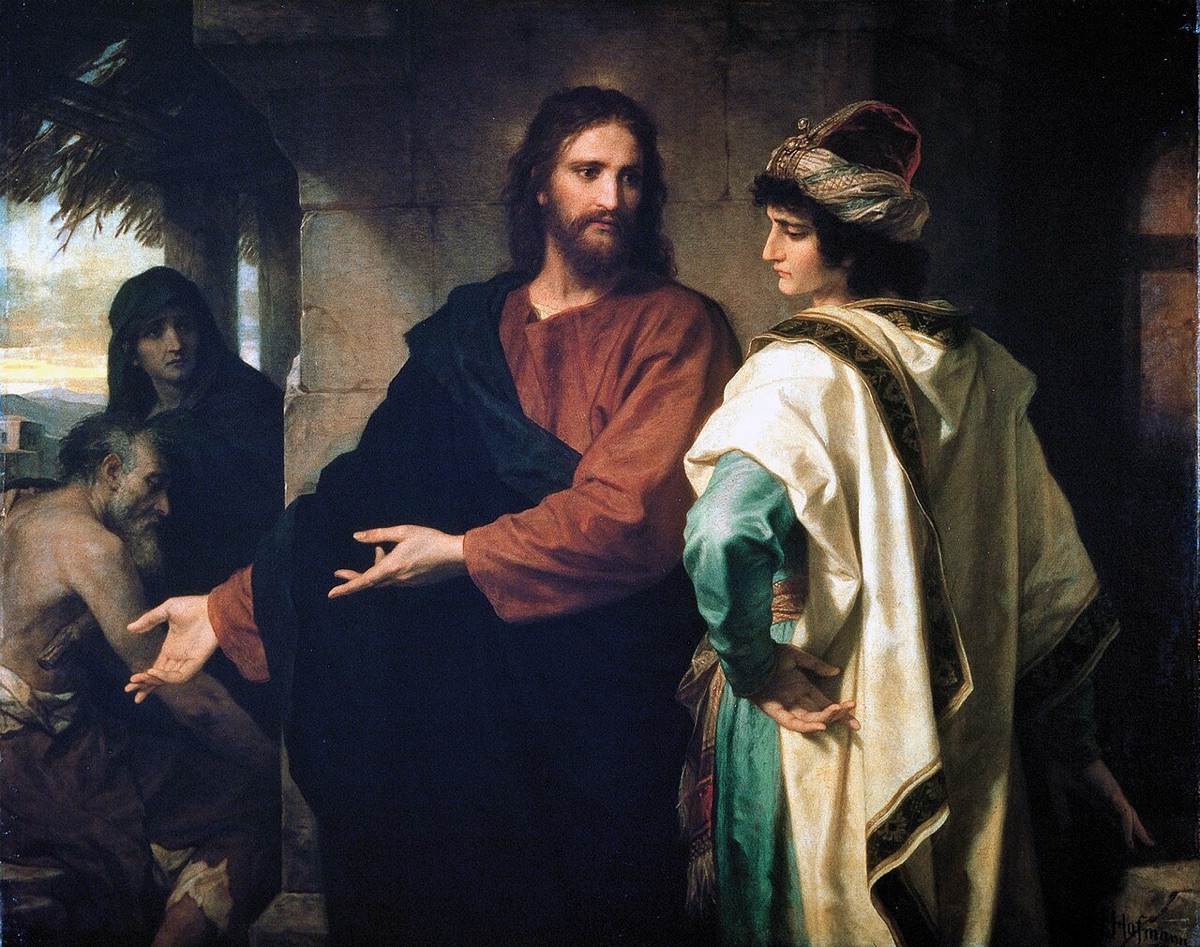 Heinrich Hofmann · 1889
Next comes the famous camel line, and that's usually where the retelling stops. In the text, the disciples are even more astonished and ask, "Who then can be saved?" The answer: "With men it is impossible, but not with God: for with God all things are possible." Why the disciples were so shaken is read in different ways. A common explanation is that wealth was then seen as a sign of God's blessing, so if even the blessed find it hard, who has it easy? I also read it like this: nobody gets in on their own strength, and a rich person finds that harder to admit, because he has something to lean on other than God. That's my reading, not doctrine.
There are two popular stories about the eye of the needle, and both are weak. The first says "the Eye of the Needle" was a narrow gate in Jerusalem that a camel could pass only on its knees. People have told this story since at least the 11th century, but there is no evidence such a gate ever existed. The second says the Greek word for "camel" (kámēlos) should read "rope" (kámilos); it goes back to Cyril of Alexandria and rests on two similar-sounding words. Both try to soften a line that is harsh on purpose: a camel through a needle means "impossible," and right after it comes the answer about what is possible with God.
Now an honest caveat. The words "them that trust in riches" are missing from some early manuscripts, and modern translations such as the NIV move them to a footnote. So I won't build a conclusion on that phrase alone. There are places where there's nothing to argue about. In 1 Timothy 6:17 Paul writes: "Charge them that are rich in this world, that they be not highminded, nor trust in uncertain riches, but in the living God," and the next verse asks them to be "rich in good works." The rich aren't told to give everything away there. They're told where to put their trust.
Are money and spirituality compatible? "Ye cannot serve God and mammon" and Zacchaeus, who gave half
A skeptic will bring up another verse right away: "No man can serve two masters... Ye cannot serve God and mammon" (Matthew 6:24). Mammon is an Aramaic word for wealth. The key word is "serve." Having money and serving money are different things; the verse asks who your master is, and the size of your account isn't its subject.
The clearest example is Zacchaeus, a chief tax collector and a rich man. After meeting Jesus he says: "Behold, Lord, the half of my goods I give to the poor; and if I have taken any thing from any man by false accusation, I restore him fourfold" (Luke 19:8), and he hears: "This day is salvation come to this house." The young man was told to sell everything, Zacchaeus gave half, and both stories are about what comes first for a person. So I read the demand on the young man as a test meant for him, and I don't take it as a rule for everyone.
People read it this way long before us. Around the year 200, Clement of Alexandria wrote a whole treatise, Who Is the Rich Man That Shall Be Saved?, in which he calls wealth an instrument: used skillfully, it serves righteousness; used badly, it becomes an instrument of wrong. There's no ban on wealth in these texts. The everyday conclusion "money and spirituality don't mix" was made from one line pulled out of a conversation.
| What people say | What the text says (KJV) | What changes |
|---|---|---|
| "The rich won't get into heaven" | "Charge them that are rich... nor trust in uncertain riches, but in the living God" (1 Tim 6:17) | It's about trust: what you lean on when you're scared |
| "It's impossible, period" | "With men it is impossible, but not with God" (Mark 10:27) | Impossible on your own strength, for anyone, poor included |
| "Money is the root of all evil" | "The love of money is the root of all evil" (1 Tim 6:10) | The evil is in the love of money; the thing itself is neutral |
| "You can't serve God and money" | "Ye cannot serve God and mammon" (Matt 6:24) | You can't serve money; owning it isn't forbidden |
Is money the root of all evil? The verse says "the love of money"
The second quote gets mangled even worse. In 1 Timothy 6:10 it reads: "For the love of money is the root of all evil: which while some coveted after, they have erred from the faith, and pierced themselves through with many sorrows." The subject of the sentence is the love of money.
One verse earlier there's a line that's uncomfortable for my readers, and I won't skip it: "But they that will be rich fall into temptation and a snare." That's a warning about the desire to get rich itself. Here's how I see the difference. When the goal is "get rich," money becomes the master, and a person will do almost anything for it. When the goal is the work, the people it helps, the craft, money becomes a measure of how well the work is done. You still want the money. It just stands second.
The difference between "money" and "the love of money" is the whole point. If evil lives in the object, the only honest way out is not to have it, and then poverty automatically makes you a better person. If evil lives in the relationship, poverty guarantees nothing. You can live on pennies and think about money from morning to night, envy, count what others have, skimp on your own mother. And you can earn a lot and stay calm about the number in your account. I've met plenty of both, and somehow the first kind never gets called money-lovers. Three questions to check yourself: do I think about money when I have enough? Would I lie to a client for a sum? Can I give without counting afterward how much I gave?
Is it wrong to charge money for helping people? How I swung into working for free
Among helping professionals this belief has its own wording. In May 2020 I recorded a video that began: "You can't make money from spirituality. I hear these words very often from all kinds of practitioners." The root is the same as the heaven line, plus a hero story. In my webinars I tell the Superman story: he saves a bank, the director hands him a check, and the hero refuses, because heroes don't take money for doing good. The work you love lands in the same "service" box, and you end up charging for what drains you and giving away for free what you do best. I took this scene apart in Ashamed to charge for what comes easy.
I lived in that distortion myself. In June 2020 I wrote an angry post: "Because I teach something almost every day, and 95% of my talks are free, nobody values it anymore." I announced there would be no more free intensives and that I'd give my energy to people who had already chosen to be my clients. Rereading it now is a bit funny, because three months earlier I had described a rule that, at 95%, I was obviously not following.
Here's the rule. Charity comes in money and in time. Work out your monthly income and what one hour of your work is worth. Every time you help someone for free, write down the hours and convert them into money. All your free help, money and time together, shouldn't exceed 10% of your income: if you earn $1,000, you help for free up to $100. This is my personal measure, not the church tithe, and it lets you say "yes" to friends calmly and name your price to everyone else just as calmly. Help with no limit ends in resentment toward the people you helped. I tested that on myself.
Charging for the work of a therapist or a mentor is as legitimate as paying a surgeon, and here even Scripture sides with the practitioner: "the labourer is worthy of his hire" (Luke 10:7). Honesty is about something else. Don't promise what you can't deliver, and don't take money from someone your work won't help.
When there's money but no meaning: my six months on the couch
I know the other side firsthand too. In 2012 I sold my chain of clubs and had more money than I'd ever seen. I fell onto the couch and stayed there for almost six months. I didn't want anything, I didn't know where to go or why, business for the sake of business felt boring, no niche lit me up. I only got up when the money ran out and life forced me.
Five years later a big businessman came to me for a consultation, the owner of six companies, with trucking and businesses in Malibu and Europe. The first thing he said: business is fine, I'm here for something else, I've lost the thrill. That's when I wrote down a model I still use. Material life has five levels: destitution, poverty, sufficiency, wealth and luxury, when you have things you don't even need, a third yacht and a fourth plane. The first two levels are stressful, and so is the fifth, because that's where you realize you can't take it with you and ask: "So what? What now?"
Material growth is finite; sooner or later you hit a ceiling, while professional and spiritual growth has none. So I advise setting your goal where you grow in substance and treating money as measurable proof that you're moving at the right pace. What put me on the couch was money with no work behind it, and many practitioners have the opposite problem: the work is there, but there isn't enough to buy their mother's medicine. What happens when a goal stops giving you energy, I covered in How to get motivated to achieve your goals.
Are rich people unhappy or less ethical? What the research shows
The belief that "wealth corrupts" rests on two claims, and both can be checked. I'm not a researcher; I read published studies and report the conclusions the way the authors state them.
Happiness. For a long time it was believed that happiness stops rising above a certain income. In 2023 Matthew Killingsworth, Daniel Kahneman and Barbara Mellers combined their conflicting data and found that the plateau exists only for the unhappiest group. For everyone else, well-being keeps rising with income, and for the happiest it even accelerates. Money above a certain level doesn't cure an unhappy person, but the claim that money stops mattering after some amount didn't hold up overall.
Spending. In 2008 Elizabeth Dunn and colleagues showed in Science that spending on others is linked to more happiness than spending on yourself. It showed up in a national survey, in employees who received a bonus, and in an experiment where people were randomly assigned whom to spend money on. How a person spends mattered more than how much they got.
Ethics. The most uncomfortable study came out in 2012: across seven studies, Paul Piff and colleagues found that upper-class people were more likely to cut off other drivers, lie in negotiations and cheat to win a prize, partly explained by more favorable attitudes toward greed. Later one of those studies was replicated four times, and a meta-analysis did not confirm that greed changes the link between status and dishonesty. Attitudes toward greed predicted dishonesty in three of the four replications; status on its own, in only one. For science this debate isn't settled, and I won't pass it off as proof of anything.
Two extremes: the rich miser and the "super-spiritual"
In 2017 I wrote: "Don't tell me how much money you have, don't tell me how many cars you have. Tell me how many people you've made happier." And I added right away that this doesn't mean being a "vacuum cleaner" that cleans everyone else and stays dirty inside. People live in extremes: either a rich miser with an inflated ego, or the "super-spiritual" type who talks about world peace but can't buy his mother medicine or pay her rent. I'm closer to the middle, where a person has realized himself, covered his own needs and still keeps the focus on people.
Refusing money out of pride keeps you on the same leash as greed. In 2019 I shared a thought from Alexander Menshikov that explains it better than I can: if you can't deny yourself something, it controls you; if you reject it completely, it rules over you, because it has cut off a piece of your reality. A person who is proud that he doesn't need money thinks about it no less than the one who hoards it. How this belief turns into an income ceiling, I showed in Money only comes through suffering.
How to combine money and mission: five steps
This is the order in which I work through the question with people stuck between "earning" and "serving."
- Write down what bad things you think about rich people. Three to five words: greedy, unscrupulous, lonely. Next to each, write the name of someone you actually know. Usually only one or two real people make the list; the rest comes from movies and other people's talk.
- Check what you lean on. Three questions: what do I trust when I'm scared? What would I do with ten times my current income? Who exactly am I ashamed in front of when I accept payment? An honest answer to the third question often names a specific person from childhood.
- Set your goal where you grow. A goal in your profession or your work, money as the measure of pace. A goal of "just earning" stops giving energy the day you reach it; that's exactly what happened to me after I sold the clubs.
- Say your price out loud. A price you're ready to say to someone's face and explain what they get for it. A discount out of guilt and a markup out of fear get in the way of the work equally.
- Calculate your ten percent. Your hourly rate times the hours of free help in a month, plus the money you give. If it comes to more than ten percent of your income, you're giving away what you need to live on, and soon you'll resent the people you help.
One more thought about whom to give to. We're used to helping the weak, and in 2019 I suggested supporting the strong too: the teacher who walks into a classroom every day, the inventor, the first-time founder, anyone whose actions show they'll use the money with purpose. You can start today: write down your five words about the rich from step one and count how many hours of free help you gave last month.
Frequently asked questions
Can you be rich and spiritual?
Yes. The Bible doesn't forbid wealth: 1 Timothy 6:10 calls the love of money the root of all evil, and 1 Timothy 6:17 tells the rich not to trust in uncertain riches but to be rich in good works. The problem is attachment, and poverty doesn't protect anyone from it.
Is it wrong to charge for healing or coaching?
No. Charging for the work of a therapist, coach or healer is as legitimate as paying a doctor, and Luke 10:7 says "the labourer is worthy of his hire." What's wrong is promising what you can't deliver and taking money from someone your work won't help.
Is money the root of all evil?
No, the verse says "the love of money is the root of all evil" (1 Timothy 6:10). The evil sits in a person's relationship with money, so a poor person can love money and a rich one may not.
Are rich people less happy?
A 2023 study by Killingsworth, Kahneman and Mellers found that for most people well-being keeps rising with income, and only the unhappiest group plateaus. Dunn's 2008 study adds that spending on others brings more happiness than spending on yourself.
How do you balance money and mission?
Set your goal in work where you grow and use money as the measure of pace. Name a price you can say to someone's face, and decide in advance how much free help you give, for example up to ten percent of income in money and time combined.

Next step — pick a format
A 5-day game for experts — from zero to your first $1,500
Start free →5 days — how a practitioner and entrepreneur puts AI to work
Learn more →Build a producer team around an expert in 30 days
Learn more →A private community of entrepreneurs — growth without the operational grind
Learn more →Money and mission on one route
In the free version of the Alliance you take a level test, and the system builds a route for your stage: how to name your price, where to grow and how much to give without hurting yourself.
Take the test