An Investor Handed Me $32,000 in Cash and Never Asked for a Signature
Three of us sit in the office Alexander rents: me, my mother, and him. I'm nineteen. The night before, it took half an hour to explain to my mother where I was about to invest money I didn't have yet. Alexander stays quiet for ten seconds, flips through the printed business plan, then reaches into his jacket pocket and empties a stack of bills onto the table. Thirty-two thousand dollars. No bank, no notary, not one piece of paper with my signature on it. "Launch it," he says, and stands up, as if he'd just decided to buy me a coffee instead of closing the biggest deal of my life.
That evening will split my life in two, but not the way I think it will that night. Not because of the money, and not because of the club that opens two months later. It splits because of what I learn about myself over the next three years, while those thirty-two thousand dollars turn into a line at the door, then into police visits at 3 a.m., then into someone else's signature on an order to shut me down right before New Year's.
The Question People Keep Asking Me Wrong
People still write to me with an idea and no money, and the question is almost always the same: where do you find an investor when you have nothing to your name? Today I sit on the other side of that table. I decide who gets money and who doesn't, and I know an answer that would have surprised nineteen-year-old me. It has almost nothing to do with the idea. It has everything to do with what you've already done with your own hands before the money shows up.
A Sign That Hung There, Doing Nothing, for Ten Years
I'm walking down a street I've walked for years, and I notice a sign, old and faded: Sony PlayStation. Clubs like that were everywhere in the nineties and early two-thousands, and then they died out because real computers showed up, more interesting, more useful, better graphics. I understand exactly why they died. And in the same second I understand something else: in 2009, a PlayStation 3 still beats any computer, and a single game for it costs eighty, eighty-five dollars, real money nobody spends on a whim. I grew up on consoles myself. I'm a student, and I know this world well enough to recite from memory which game came out in which year. This is the rare case where you don't choose the idea with your head. You're already the expert. You just never looked at it as a business before.
I go into my office. At the time I'm running a small company as its director, and instead of doing my actual job I spend the day writing a business plan with real numbers: rent, renovation, equipment, salaries. There's barely any useful information online back then, so I dig through what little exists and rewrite the plan fifteen times. The first version says I need about fifteen thousand dollars. By the time the plan starts to resemble reality, the number has doubled.
Mistake #1. I ran the budget once and believed it. The real cost of launching wasn't ten or twenty percent higher. It was double. That's normal for a first business plan, which is exactly why you can't write it once and carry it to an investor as a final number.
Lesson 1. The first version of any budget is almost always half of the real number. Build that in ahead of time. Don't find out after the money's already spent.
Family, Fools and Friends
Americans have a saying about where startup money comes from: family, fools, and friends. My director's salary is about three hundred dollars a month in a good month. I need thirty-three thousand. Family is out immediately. My father is already dead, and my mother is home alone with my siblings. That leaves friends. I call everyone I know and ask if anyone in their circle might be interested. People hand me contacts, I call, I meet, and almost every time I hear a polite no.
So I do what I now tell everyone who asks me how to find an investor. I don't wait for the money to start acting. I live in Odessa, a resort city, there are plenty of foreigners on the streets, and I speak fluent English. I walk up to strangers with a sheet of paper, "here's my business plan," and introduce myself. At the same time, I'm hunting down equipment suppliers, getting real renovation quotes, finding someone to make the sign, finding someone to print business cards. My first card reads: "General Director of a small café." I still have it.
By August 30th, everything is ready except the space and the money for it. I find a good spot on Cathedral Square, across from the Odessa movie theater, and call about the listing. The landlord shows up: Alexander, an American of Jewish descent, a complicated man, as I'll come to understand later. I tell him what I want to open. "I like the price, two thousand a month," I say, not quite believing myself. "All I need now is to find the money," I add honestly, instead of bluffing.
The Conversation
And then something happens that I still don't fully believe. Alexander doesn't leave. He asks what I've got, and I show him the plan. He looks at the numbers and nods. "Looks solid, kid. You seem like a decent guy. Come back tonight, I'll give you the money, just bring your mother." I'm nineteen, almost twenty, and serious people won't talk business with me without a parent standing there to vouch for me. Fair enough, for the time.
We come back with my mother. Alexander pulls thirty-two thousand dollars in cash out of his pocket. No IOU, no notarized loan agreement, not one piece of paper obligating me to anything besides my own word. "Launch it."
Much later, once I start investing in other people's projects myself, I understand what happened in that room. I've asked dozens of people who fund startups whether the idea matters to them. Almost all of them say the same thing: they don't care much what the idea is, as long as it's not on their personal blacklist. What matters is the person. What matters is whether that person is burning for it. What matters is whether they've already done something without waiting for permission. Alexander didn't give me the money because a PlayStation club struck him as a brilliant concept. He gave it to me because he saw a guy who'd already found a sign installer, a business card designer, and an equipment supplier, without a single cent in hand.
Lesson 2. An investor is rarely an expert in your niche. They're an expert in people. Everything you've already done before you asked for money speaks louder than any pitch deck.
The Club Nobody Understood
I get the money in August, and on October 10, 2009, I open the doors. I name it Newgen Club. Nine rooms, each with its own design, each with a door that actually closes, something nobody in the former Soviet space had done before. A private capsule for a couple of hours: TV, tea, coffee, you can smoke, you can relax. A guy comes in to get away from a wife nagging him about video games at home, and here he gets his own room. A room runs about twenty hryvnia an hour per person; VIP costs roughly three times that.
Here I learn something no book I'd read up to that point ever mentioned: a great idea and an understandable idea are two different things. When I tell people "PlayStation club," they picture a smoky common room, a pack of half-drunk students crammed on shared couches. Nobody knows I have closed, individual, premium rooms, because that market never existed before, and I end up explaining it to literally every single customer, one at a time.
For two years I build demand by hand, slowly, painfully, explaining the format to every new guest myself, and over those two years revenue climbs to eight thousand dollars a month, insane money for me at the time. Along the way I learn to read the business through numbers instead of gut feeling. One day I notice in the stats that the average gaming session runs one hour, eleven minutes, eleven seconds, a suspiciously round number I don't believe until I check it again the following week and get the same result. I do the math: keep a customer nine minutes longer, and revenue climbs noticeably. I design a small promotion that stretches the session without anyone noticing, and revenue really does go up, a quarter at first, then more.
Lesson 3. An idea with no comparison on the market isn't automatically an advantage. It's extra work: explaining it to every single customer, over and over, until the market catches up.
The Neighbor Everyone Hated
The club runs around the clock, and next door lives a woman that, as it turns out, everyone who's ever dealt with her despises. She calls the mayor's hotline, she calls the fire department, she calls the police, over and over. The police show up at night, because that's when the complaints come in, and I have to get up at three in the morning and walk to the club to sort out whatever's happened this time. During the day, others show up: sanitary inspectors, the fire marshal, the economic crimes unit. Not every day, once a week, once every two weeks, but regularly. Everything I run is legal, everything's properly documented, there's nothing to catch me on. In practice it all comes down to a few token fines. But in that country, if someone really wants to dig something up, they can always find a way.
On December 29th, a little over a year after opening, right before New Year's, they show up and shut the club down. No pretense about it: "Igor, we know you're clean, but there's such a stack of complaints from this neighbor that we got orders from above to just close you down, so she stops calling us." I ask if this can be solved with money. The answer: "You should have thought of that earlier."
Mistake #2. I thought that if I did everything honestly and by the book, bureaucratic pressure would never reach me. It reached me anyway, not because I broke any rule, but because the system works this way: one persistent complaint outweighs a hundred clean inspections.
Lesson 4. No business plan protects you from a hit it never accounted for. What protects you is a decision made in advance: when everything falls apart through no fault of my own, I don't sit around looking for someone to blame, I look for the next move.
I Walk Away While the Numbers Are Still Climbing
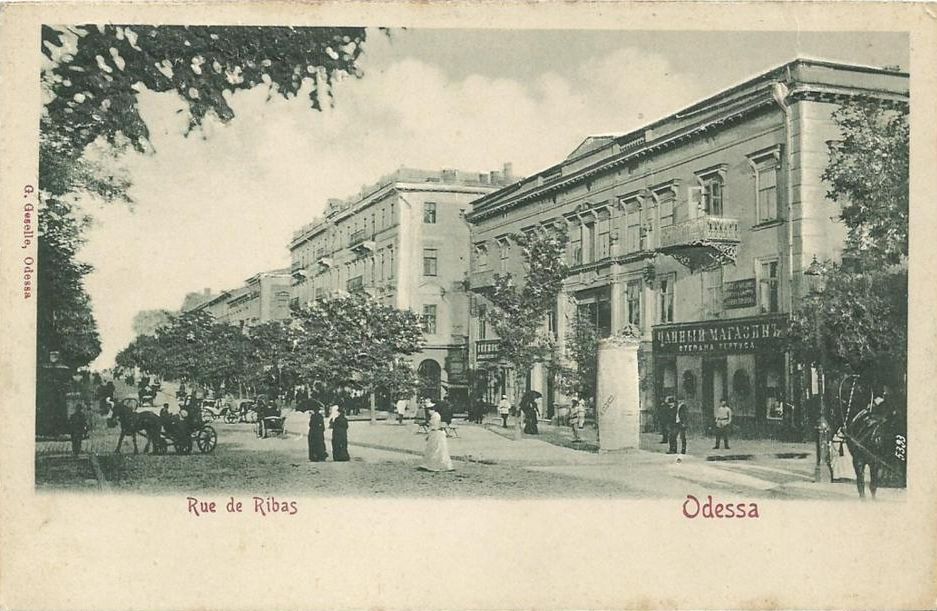 ODESSA · DERIBASOVSKAYA STREET · early 1900s
I don't fold, and I don't give up. I move to Deribasovskaya, the most central street in Odessa, and open a club under the same name, Newgen Club, almost two and a half times bigger than the first one, twelve rooms instead of nine. The move costs me almost all of my old customers and more money than the actual renovation. Newgen on Deribasovskaya picks up again, business goes well, but one day I catch myself realizing I'm no longer interested in growing this niche any further. I've squeezed out of the format everything I know how to squeeze. In 2012, a little over two years after that night with the stack of bills on the table, I sell both clubs for a hundred and twenty-five thousand dollars and pay Alexander back his forty-four thousand, with interest.
Lesson 5. Being tired of a niche where the numbers are still climbing isn't weakness, and it isn't laziness. It's a signal that it's time to run the math, instead of waiting until the numbers start falling on their own.
The Tool: 5 Steps to Find Your First Investor With No Money and No Name
If I boil down this whole path to what I actually tell someone with an idea and an empty wallet, it comes down to five steps. Not a guarantee, but something that actually gets things moving.
- Run the budget, then double it. A beginner's first estimate is almost always fifty to one hundred percent too low. That's not a reason not to start. It's a reason not to be shocked when the real number comes in higher.
- Start doing whatever doesn't cost money before you find any money. Suppliers, contractors, design, agreements, anything you can move forward without spending a single dollar, move it forward now. An investor judges you first on what you've already done without permission. The idea on paper is secondary.
- Look for someone who believes in you specifically. They rarely need expertise in your niche. Friends, friends of friends, random conversations, the investor almost never comes from where you're deliberately looking. Widen the circle of people who even know your plan exists.
- Build in the day your plan runs out. Every business hits a point where reality stops matching the spreadsheet, not "if" but "when." Whoever accepts that in advance moves faster in a crisis than whoever gets blindsided by it.
- Treat fatigue as seriously as falling revenue. If a growing business has stopped exciting you, there's nothing to be ashamed of, but it's a good reason to honestly calculate what it's worth, and sell while the numbers are still climbing, not after they've started to slide.
I Call Him Live On Air
Years pass. I post this story on social media, and some commenters say I made it up: who in their right mind hands a nineteen-year-old stranger thirty-two thousand dollars in cash with no paperwork? So, half-joking, live on a broadcast, I dial Alexander's number and put him on speaker in front of everyone. I ask him the question I never once asked him in person over all those years: why did he give me the money that day? He doesn't mention the business plan, the numbers, or any of the math. He says one thing: that he saw a kid with fire in his eyes, and he knew that kid would make it work. Twelve years later, that's still the only reason I ever pull money out of my own pocket and tell someone, "launch it."
So what have you already done with your own hands, while the money still isn't there?
Frequently Asked Questions
How do I find my first investor if I have no money or experience?
Start doing what doesn't require money: line up suppliers, contractors, a location, and run the real numbers. An investor is rarely an expert in your niche — they're looking at you, and at what you've already done without spending a cent. Widen the circle of people who know about your plan: your first investor is almost never where you're deliberately looking for them.
What matters more to an investor, the idea or the person?
The person. Almost everyone who funds a startup says the same thing: they don't much care what the idea is, as long as it's not on their personal no-go list. What matters is whether the founder is burning for it and has already done something without waiting for permission. The idea on paper is secondary.
Why does a business plan almost always underestimate the real budget?
A beginner calculates using the prices they know and doesn't account for what they don't know yet: unexpected work, downtime, second attempts. The first version of any estimate usually comes in fifty to one hundred percent low. That's fine, as long as you build in a buffer ahead of time instead of discovering it after the money's gone.
What do you do when people start filing complaints against your business for no real reason?
Keep everything as legal and well-documented as possible, so inspections have nothing to grab onto, but understand that one persistent complaint can trigger the whole machine regardless of whether you did anything wrong. Prepare for it in advance, not legally, but mentally: when everything falls apart through no fault of your own, don't look for someone to blame, look for the next move.
How do you know it's time to exit a business and sell it?
One honest signal is losing interest in a niche where the numbers are still growing. If a business keeps making money but you no longer feel excited to grow it and sense a ceiling, that's a reason to calculate its value and sell while it's still trending up, not after it starts sliding down.

Next Step — Choose Your Format
A 5-day game for experts — from zero to your first $150K
Start free →5 days — how to apply AI in the work of a practitioner and entrepreneur
Learn more →A practical program: from chaos to a managed flow of clients and steady income
Learn more →A closed international community — the environment where scale becomes a habit
Apply →Ready to launch, even before the money is there?
Join a community where an idea turns into a business not by the book, but with your own hands, next to people who've already done it.
Learn More