Nothing is working in your business? You mistook a hypothesis for a plan
If nothing is working in your business, check your expectations before you blame yourself. Odds are you expect something you're doing for the first time to work on the first try.
When your business isn't working, stop treating your plan as a plan. It's a hypothesis, and only the market can confirm it with money or reject it. So write down a forecast before you launch, test cheaply and often, change one variable at a time, review the numbers every week, and keep the goal while you change the methods.
My partner Sasha Turubarov, who runs programs for experts with me, recently brought up his old English-teaching project. By his count he rebuilt the website for it thirty-six times. He'd sit up at night rewriting it, and it still didn't work. Then it did, and things took off. He also rewrote one webinar forty-seven times before it started selling. I've been in business for twenty years, I've done more than two thousand in-depth interviews with entrepreneurs, and I still miss with offers, websites and webinars. Below I'll break down why this happens to everyone, how to turn misses into a system, and when to quit your business vs keep going with a new approach.
Why nothing is working in your business the first time: your plan is a hypothesis
There's one phrase that genuinely drives me up the wall: "I don't know how to do this." For the rest of your life you'll keep running into tasks you've never done before. That's what growth is. What you already know how to do gets you the result you already have. If you make income A now and want income B, and you've never made income B, of course you don't know how to make it today. Don't know? Find out: look it up, try it, test it.
Once a goal goes beyond your usual routes, its nature changes. A business hypothesis is an assumption of the form "if I do this, by this date I'll get that," which reality can test. I think you should sell like this, shoot videos like this, run ads like this. I put that idea up against the market. If I'm right, the feedback comes in as money. If no money comes, the hypothesis was false, but I got an honest answer. Now I know one way it doesn't work, and the next attempt will take that into account.
Back in 2020 I broke down the management cycle on my channel, and step one is forecasting. If you're growing the right way, ninety percent of your tasks will be challenges you've never faced. That means you have no experience, only a hypothesis: "if I buy an ad in Forbes, I expect this return." Then come the team, a plan with deadlines, execution, and a review of the results, which I call reforming. The step people skip most is the first one. The forecast never gets written down, and afterward there's no way to tell whether you missed or hit.
Almost nobody gets it right on the first try, with ads or with a product. Department store owner John Wanamaker is credited with saying that half the money he spent on advertising was wasted, and the trouble was he didn't know which half. Quote historians never found direct proof that he said it, but anyone who has run ads will sign off on the idea. We know we'll get to the result, and we don't know which step will get us there. That's why in the Producer Plan I give participants about three hundred tools and ask them to go through all of them. Which ones will work in your niche, with your personality and experience, neither of us knows in advance. From what I've seen, only a handful really take off for any one person, around six.
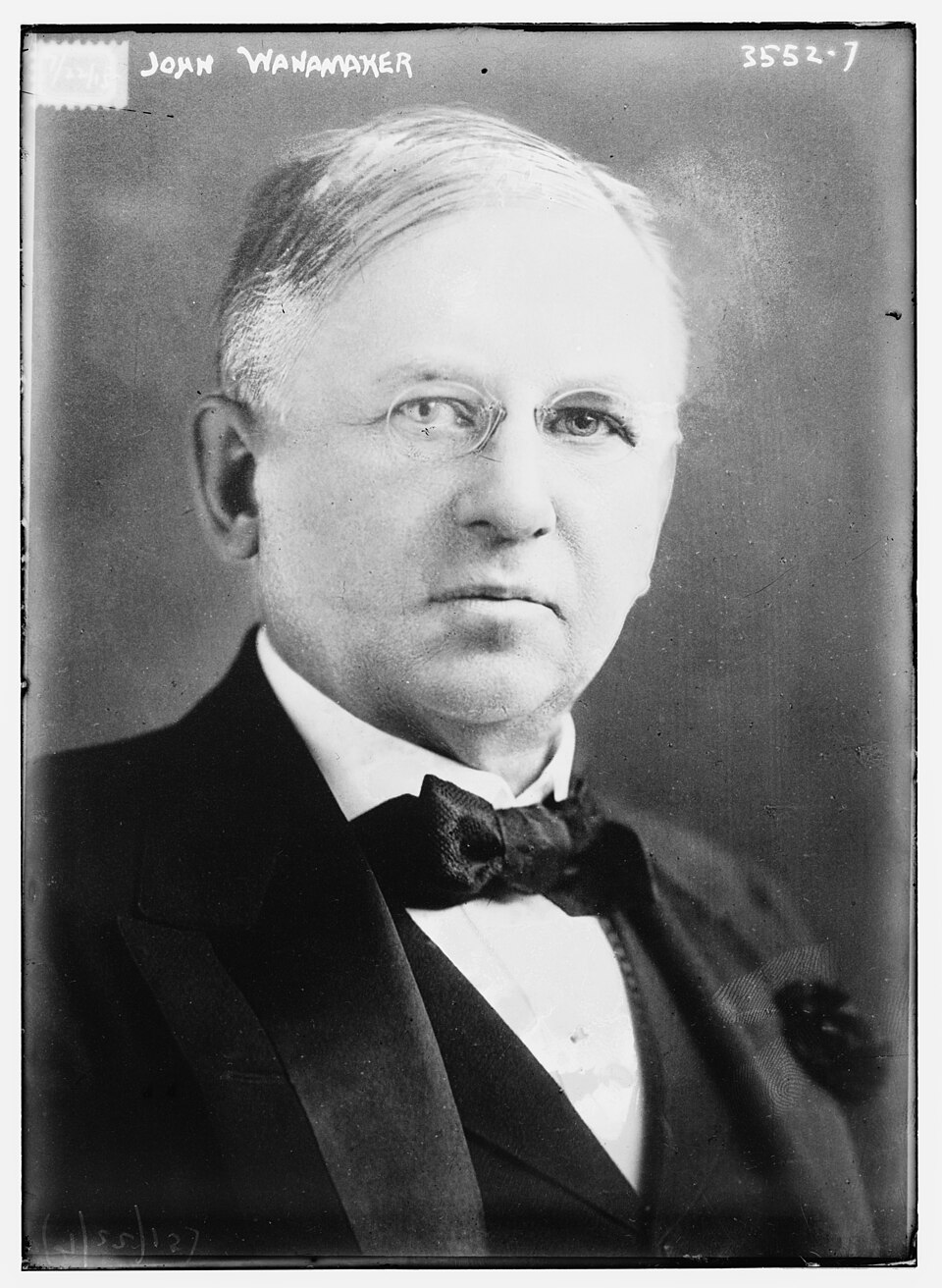 Philadelphia · c. 1915
Why it doesn't work even with experience: I'm a rookie with every new hypothesis
I often feel people expect from themselves what they don't expect from me. Sasha and I have spent almost a year fine-tuning our joint offer. We tweak it nearly every day, collect analytics and feedback, and at some point Sasha just runs out of patience. We recently launched an app called My Offer that helps people write offers for their clients, and in one week of testing we collected so much feedback and rewrote so much that it surprised us. We thought one part was perfectly clear, and people found it hard. Here the system missed, there it didn't land. We sit there like rookies, staring at the analytics and thinking: people dropped off here, it's confusing here, it's a struggle here.
The club went the same way, only it took years. In 2019 I tried an educational club, basically a subscription to knowledge, and it turned out nobody is going to study nonstop. People dropped out. The next version was built around my regular talks so people could recharge on the energy, but my energy isn't infinite, and that setup creates a personality cult. The third version was the most interesting one. I mapped out a person's whole development path through PERL, with every stage, exercise and book, and in practice it turned into a correspondence course. We all know how much actual studying happens in those. In 2024 I shut that version down, because the only thing holding people together was me. Three versions, three honest "no"s from the market, and each one showed me what to change next. Today the club lives on in a new version as Freeman's Alliance, and we keep fine-tuning it.
I've been on Instagram since 2012. From 2012 to 2019 I had about four thousand followers, and the whole time I wrote a post every single day. Now people tell me, "You write so well." I tell them, "Write as much as I have in my life."
So if you expect a result in your first thirty days that I, with all my background, don't get right away, the question is simple: are you planning to outplay me on skill in a month? Most likely you'll need more attempts than I do, and that's normal. It'll work on the twelfth try, the fifteenth or the twentieth. Who cares which.
How to test business hypotheses: first find where the chain breaks
"Nothing is working" is almost never the whole truth. Usually one link breaks. People don't see you (no reach), they see you but don't reach out (no leads), they reach out but don't buy (no sales), or they buy once and never come back. Each link needs its own hypotheses. If there are no leads, rewriting your sales script is pointless, and if you have leads but no sales, shooting more videos is pointless. So the first hypothesis is always about where exactly people dropped off.
Next comes the main question I ask in reviews. Nobody knows in advance which hypothesis will work, so that's the wrong thing to worry about. What matters is how many hypotheses you can test in a short time and how honestly you test them. Almost any business process works so that one attempt that lands pays for nine that didn't, but only if each test was cheap.
Research backs this up. Italian researchers Arnaldo Camuffo and Alfonso Gambardella ran a randomized experiment with colleagues on 116 startups. Both groups got the same training in collecting market feedback, but one group was also taught to work like scientists: make a forecast about their idea and rigorously test hypotheses. The other group judged its ideas by gut feeling. Over a year of observation, the "scientists" performed better, pivoted more often, and still didn't quit any more often than the control group (Management Science, 2020). For me the last part matters most. A hypothesis-driven approach doesn't make a person indecisive. It shows them exactly what to change.
Let's run a simple example. Say it takes roughly a hundred videos for one to blow up. That's an illustration, not a law: some people have shot three hundred and never gone viral because they kept making the same thing. If you shoot one video a week when you feel like it, a simple task takes you years. At five a day, it's a matter of twenty days. But volume only works together with review. Once a week, look at the numbers, find your best and worst video, and change one thing. Volume without review is exactly how you end up with those three hundred videos sent into the void.
One more thing that saves a lot of nerves: much of what you believe about the market will turn out to be false. Try ranking your potential clients on a ten-point scale by who you think will buy. In my experience, the scores will be wrong more often than you'd think. Often the people you gave a one are the ones who buy, and the ones you were counting on most say no. Your client list is a hypothesis too, and you test it with phone calls rather than by thinking about it.
Expectations and disappointment: why it hurts so much when things don't work
There's a popular definition of happiness: results minus expectations. You set a goal of making $100,000, made $80,000, and got upset, even though $80,000 is an amazing result. Someone else aimed for $10,000, made $11,000 and is thrilled, even though that's almost seven times less.
This everyday wisdom has science behind it. Neuroscientist Robb Rutledge of University College London and his colleagues built a model that predicted people's mood in a game with small wins and tested it on 18,420 participants through a smartphone app. The finding: moment-to-moment happiness depends less on how well things are going and more on whether they're going better than you expected (PNAS, 2014). The experiment measured momentary mood in a game rather than annual revenue, but I think the mechanism is the same.
Now look at what building expectations in business really means. You're unconsciously trying to predict how the world will react, and even to tell it how it should react to your offer, your ad, your sales pitch. When people react differently, you get upset, even though they were never obligated to react your way. So I suggest replacing the expectation "it should work right away" with "the first attempts won't work, and my job is to find out why." With that bar, a miss stops hitting your self-esteem and becomes data. I wrote more about the fear of missing in how to overcome fear of failure.
"Lie facing your dream": why hope keeps you from admitting you're stuck
There's a motivational line: if you can't walk toward your goal, crawl; if you can't crawl, at least lie down facing it. Sounds nice, but honestly, the idea is useless. That's exactly why so many people can't admit they've given up: the hope stays, the movement doesn't.
After one of my talks, a man messaged me: "I've been in network marketing for five and a half years, I have three people on my team. Igor, help." I asked, "How many meetings did you have last week?" If you've signed three people in five and a half years, it's not hard to guess there are almost no meetings. He hasn't thrown in the towel, but in reality he's standing still. I started in network marketing myself in 2006, and I've never heard "no" as fast in any other business. That's also what toughens you up: walking toward people knowing they're about to tell you to get lost.
A dream without a deadline is a fantasy. Until your goal has a date, there's no hypothesis, only hope, and you can't test hope. I explained why work doesn't start without a deadline in why I only work under deadline pressure, and why people quit right before the breakthrough in why do people quit right before they succeed.
When to quit your business vs keep going with a new hypothesis
"Never give up" is easy to misread as an order to keep banging your head against the same wall for years. What I mean is different: you hold on to the goal and change hypotheses as many times as it takes. I didn't drop the club after the first version or after the third. I closed versions. Sasha didn't drop his English project after a website flopped. He rewrote the website.
| You're hitting a wall | You're doing normal work | |
|---|---|---|
| Attempts | the same thing, expecting a different result | each differs by at least one variable |
| Records | no forecast, results not counted | forecast written before launch, checked against the facts |
| Takeaway | "bad luck," "wrong market" | you can say what the attempt taught you |
| Money | has anyone paid? no one | first payments or repeat buyers |
Before you shut it down, answer four questions. How many months can you keep testing hypotheses without going into debt you can't repay? Better to name that number before you start than to discover it with an empty bank account. Has anyone paid you, even once, of their own free will? If so, there's a living core, and you should change the method and keep the business. How many honest iterations have you run, changing one variable at a time? Do people recognize their own pain in your offer? If they still don't after a series of attempts, the problem is usually the offer itself, and it's time to go back to how to create a coaching offer instead of pouring more money into ads. What you usually close is a product version or a channel. The whole goal goes only when it has stopped being yours.
What to do when your business isn't working: 6 steps
- Find the link where the chain breaks: reach, leads, sales or repeat purchases, and build your first hypothesis around that link.
- Rewrite your plan as a hypothesis. The formula: "If I do X, by such-and-such date I'll get Y." If you can't fill in Y and the date, what you have is still a wish.
- Write down your forecast before launch. How many leads, sales and replies you expect. Without a forecast you won't know whether you missed or hit.
- Lower the bar for your first attempts. Tell yourself up front: the first ones won't work, and my job is to find where people drop off.
- Test cheaply and often, changing one variable at a time. Five videos instead of one, ten calls instead of a post once a month, and a review once a week: headline, price, audience or channel, just one thing.
- Set a deadline and make a grown-up decision. A date, a number of attempts and a budget for testing, and then the line: "With you or without you, I'll get the result."
Where I might be wrong
Not every goal is worth cycling through hypotheses for. If the goal isn't yours and came from someone else's expectations, no iteration speed will help. I wrote about that in why can't I achieve my goals. One more thing: if "nothing is working" now describes your whole life, you've had no energy for weeks and nothing brings you joy, it may be depression. That's a reason to see a doctor before you build another funnel.
With you or without you
The most important decision, the one that determines whether you make it to your tenth attempt, sounds like this: with you, Igor, or without you, I'll get the result. If the result depends on the mentor, the person is still in a child's position, looking for a course to save them. If they tell a trainer, "With you or without you, I'll get in shape, with you it's just faster," that's an adult position. Then they pull the answers out of the mentor themselves instead of waiting to be spoon-fed. Take your plan right now and rewrite the first line as "if I do X, by such-and-such date I'll get Y." That line is where the work starts, the work you used to call "nothing is working."
FAQ
What do you do when your business is not working?
Find the link where the chain breaks (reach, leads, sales or repeat purchases) and rewrite your plan as a hypothesis: "if X, then Y by a date." Write down a forecast before launch, test cheaply and often, change one variable at a time and review the numbers weekly. The goal stays. The methods change.
Is it normal for a business not to work at first?
Yes, it's normal even for experienced people. I've been in business for twenty years and I still rewrite offers, websites and webinars many times over. My partner Sasha Turubarov rewrote one webinar forty-seven times before it started selling. The first attempt is almost always reconnaissance.
How do you test a business idea quickly?
Test it by hand and for free: calls, direct messages, meetings, posts and videos instead of paid ads. Phrase the hypothesis as "if X, then Y by a date," write down the forecast, make a series of attempts and compare the results with the forecast. The cheaper each test, the more of them you can run in a week.
How long should you give a business before quitting?
Name the term before you start: how many months you can keep testing without going into debt you can't repay. Then judge the work itself. If every attempt differs from the last, you can say what it taught you, and someone has already paid, you're doing normal work and should change the method. If you've repeated the same thing for years with no records and no payments, you're hitting a wall. Usually you close a product version or a channel and keep the goal.
Why do I get discouraged so easily?
Because what upsets you is the gap between the result and your expectation more than the result itself. In Rutledge's study of 18,420 participants, mood depended on whether things were going better than expected. Expect the first attempts not to work, and a miss becomes information.

Next step — pick a format
A 5-day game for experts — from zero to your first $1,500
Start free →5 days — how a practitioner and entrepreneur puts AI to work
Learn more →Build a producer team around an expert in 30 days
Learn more →A private community of entrepreneurs — growth without the operational grind
Learn more →Let's pick the first hypothesis to test
Book a session: we'll turn your plan into hypotheses with a forecast and a deadline, and choose what to test this week.
Apply