I'm standing on the mat, and Vitalik doesn't even see me.
He sees me, technically. But the way you glance at a price tag for something you don't need. A sliding, unengaged look. Sixteen years old. Quarterfinals of an international tournament in Kishinev. Russia, Ukraine, Moldova — everyone's here. I just remembered I forgot to drink water before stepping out, and now my mouth tastes like iron from nerves. The judge is saying something in Moldovan, then in Russian, I'm not listening. My coach is somewhere behind me. The hall buzzes. I look at Vitalik and I'm thinking one thing.
"He doesn't remember."
Eight years, man. Eight years of every single day on the sparring mat, same weight class, same coach. And he doesn't remember. Fine. That means I have an advantage he doesn't know about.
When you're ten
Ten years old, Odessa, Youth Sports School number four. My mom brought me by the hand. I actually wanted to play football — every normal Odessa kid did. But my dad said: rough sport, you'll break your legs, crutches. Go do judo, he said. Dad was military. When dad says go, you go.
The gym smelled of sweat, tatami, and something I didn't have a word for then. I know now. It smelled like fear. A dozen boys who knew they were about to get thrown on the floor. The coach looked at me. Small, quiet, big eyes. He said: "let's try." That was his maximum investment in my future for the next five years.
Vitalik was already there. A year younger, same weight, same coach. He stood in the corner lacing up his gi with the expression of a man being inconvenienced by the existence of the room. First time someone threw me, it happened within sixty seconds of arriving. Not even Vitalik — some older kid. I lay on the tatami staring at the ceiling, dust in my nose, already knowing I didn't belong here. I just didn't understand yet that nobody belonged here, and that was the only thing keeping the gym running.
Eight years, every day
Seven trainings a week. Think about that number. Seven times a week I put on my gi, walked onto the mat, and two hours later they let me out soaked, scraped up, feeling like I understood nothing. In Odessa I won — I was the best in the city in my weight class, the coach used me as an example for newcomers, I won trophies at city tournaments, my mom hung medals in the wardrobe next to my brother's honor certificates.
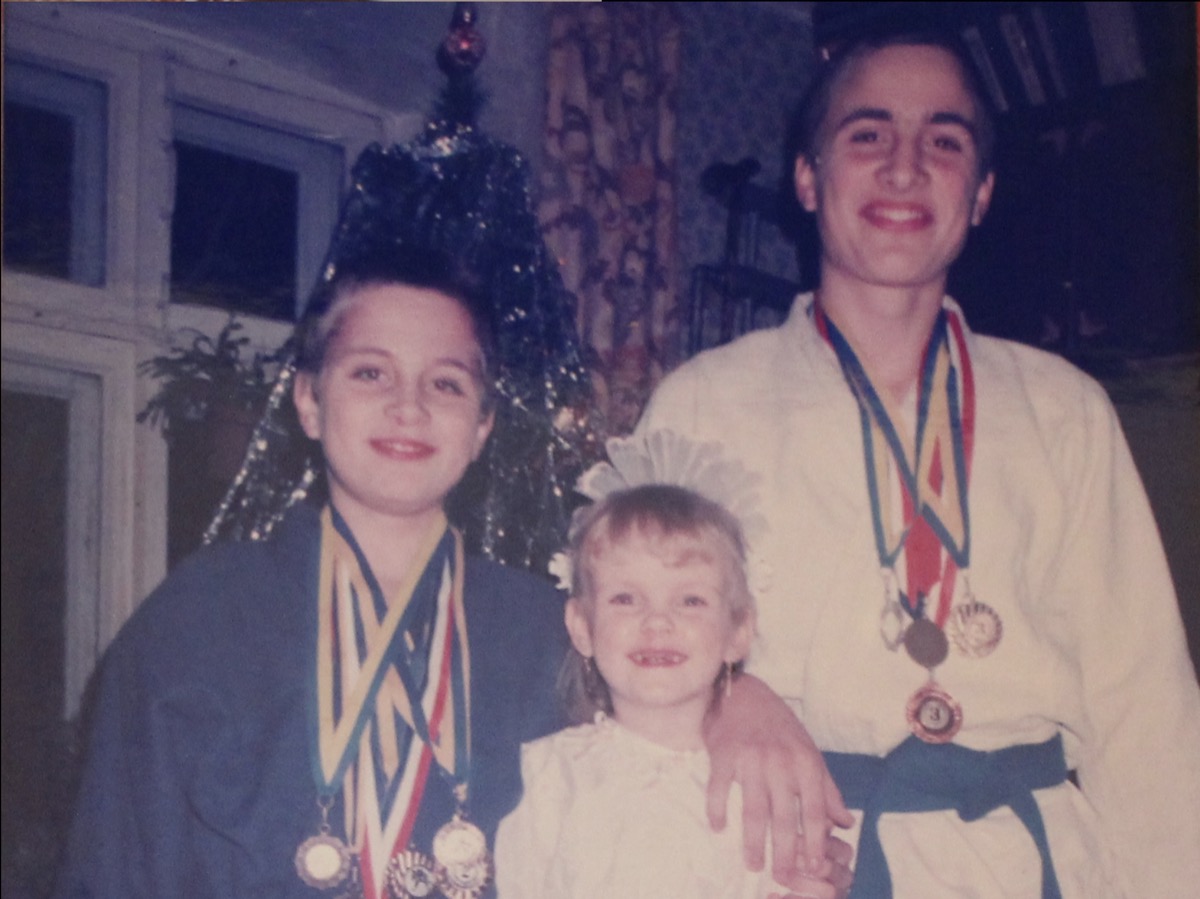
But the moment I left the city — Kishinev, Mykolaiv, Moscow — I lost. Couldn't figure it out. Same moves, same body, same brain. At home: champion. Anywhere else: nothing. Five years of this. My dad found money for every trip, even though we didn't have money. Dad was military, mom worked, three kids. He gave the last of it for trains, for gis, for registration fees. I'd leave, lose, come home.
He'd sit at the kitchen table and wait. Didn't get up when I walked in. Just looked. "Well?" I shook my head. He went quiet, poured himself a drink. Didn't get angry out loud — that was worse. Something tightened inside him. Military, Soviet, not letting himself show an emotion where his son traveled on his last money and came back without a medal. "Go eat," he'd say. I'd go eat. And the next day I'd put on the gi and go to the gym. That's how any long road of growth works — you just don't skip today.
Vitalik
If Vitalik had been a jerk it would've been easier. You can hate jerks and use it as fuel. Vitalik was worse. He was a slacker. A naturally gifted slacker with raw technique and raw aggression. The coach screamed at him for skipping sessions, he'd smile, nod, then skip again. He'd barely warm up, gi hanging off him wrong, might show up forty minutes late, walk in, check himself in the mirror, straighten his belt, and step into sparring. Then destroy everyone. Me especially.
You know the movie villain who isn't scary or loud — he simply knows he's better. That knowledge is enough. No proving, no pressing, no gloating. He just throws you and goes to get water. That was Vitalik. Once I sat down next to him in the locker room. Wanted to ask something. I don't remember what. He glanced at me. Half a second. Went back to his phone. I left without asking my question.
At school they didn't like me either. I was quiet and small, never talked back. I had a military father at home, and I already understood — in confrontations, the one who stays quiet and watches wins. So I stayed quiet and watched. They called me a twig and a few worse things. And in the gym I watched Vitalik and tried to understand what was wired differently inside him. I never figured it out.
Moscow announces a tournament
Spring 2003. The coach calls the gym together. "Moscow. Victory Day. International tournament. Hero cities only. Odessa qualifies. One person per city per weight class. City hall covers everything." The room buzzed. This was the most prestigious youth tournament we could ever get into.
The coach looked our way. At me and Vitalik. By fifteen or sixteen we were both at 66 kilos — I got there a year earlier because I was older, then he caught up, and here we are in the same weight class again. At sparring it changed nothing, we still went head-to-head every day. But there was one spot at the tournament. The coach didn't hesitate. "The 66-kilo spot goes to Vitalik," he said. I nodded. No time to get angry. It was obvious — Vitalik had better chances internationally, he was the one to send.
The coach didn't leave. "Graf," he said. "There's nobody strong from Odessa at 60. You can cut to sixty. Win the city. Go as first seed." I said nothing. "Four kilos," he said. "Three and a half weeks. You won't make it." He was looking at me the way you look at someone you just invited to drown themselves to learn how to swim. "I'll try," I said. The coach shrugged.
The guy who'd been holding the 60-kilo spot from Odessa was two years younger than me. A good guy. I called him that evening. "I heard," he said. "I heard you're coming in. I'll step aside." I held the phone and said nothing. "Seriously," he said. "You're stronger than me. I won't fight you for it. Take the slot. Go. When you win, share the medal." I put down the phone and sat for a few minutes staring at the wall. That was the first real investment anyone had made in me outside my family. From a guy who owed me nothing. Since then I've known: almost every goal you reach starts with someone believing in you before you believed in yourself.
Three and a half weeks on water
I ate water and pieces of black bread. That's a diet, not a metaphor. Morning: a glass of water. Lunch: a glass of water and a small piece of black bread, a finger's width thick. Evening: sometimes a glass of 1% kefir. If I was lucky. I went to school every day, to training every day, seven times a week — only now I did all of it hungry.
By the end of the first week I stopped following what teachers said. Not because I couldn't hear — words arrived with a delay, like a lagging video. By the end of the second week my hands started shaking. Not badly, but when I held a notebook, I could see it. By the end of the third I weighed almost sixty kilos. Every evening I put on my gi, then a jacket on top, it was May — Odessa May, warm, thick, with acacia in bloom outside the window — and I walked out of the building and ran circles around the block. Around and around. To sweat, to push water out, to burn calories that weren't there.
Neighbors watched from windows — kid's lost his mind, jacket in May, running circles. My mom said quietly one time, when I came back in: "Maybe you don't have to?" I didn't answer. Dad stood in the hallway and watched. Quiet. Poured himself tea, sat down. "He does," he said. To nobody. Into the room. I went to shower.
The road to Moscow
I always traveled to competitions on my own — my dad's money, really. No money for food on the road. I'd pack a coil-style water heater, drop it in a cup of water, sixty seconds to boil, and a pack of instant noodles. On the train, some guy across from me with a newspaper and garlic sausage on white bread, the sausage smelling up the car, I'd turn toward the window, heat water, then heat noodles in that same cup. That was every trip. Five years of losing, outbound on instant noodles, back home on instant noodles.
Moscow was different. We went to Moscow as an official delegation from a hero city. The city hall covered trains, we got vouchers for proper dining car meals, and Odessa put its entire youth judo team on that train — nine people across different weight classes and age groups. Among those nine was Vitalik. He was going at 66, his natural weight, no cuts. I was going at 60, and I still needed to drop over a kilo more. We lay in the same train car, two bunks apart, falling asleep to the same rhythm of the wheels. First time in eight years we were going somewhere together.
I was in no state to read into signs and coincidences. I didn't have the energy to stand up from my bunk. I lay by the window counting the fluorescent lights on the ceiling and tried not to think about food. The guys in our car were playing cards for forfeits. Our guys had gone to hang out with some chess players from another delegation, someone was running two games simultaneously, our people were laughing and arguing till morning. The next car over had figure skaters; our guys went to introduce themselves, came back with brewed tea, went again. It was fun.
I wasn't having fun. The smells from the whole car kept hitting me — someone's instant noodles, tangerines from someone's bag, a box of chocolates going around. I covered my face with the pillow and tried to sleep. Couldn't. At some point Vitalik walked past my bunk. He'd changed into a sports shirt and was heading to the dining car. He looked down at me the way you look at someone else's bag under the seat. And walked on. A minute later I could hear his laugh from the corridor, with one of the chess guys. I didn't know what I would've said to him right then if I'd had the energy. But one thought sat quietly in me. He was going to eat. I was lying here not eating. And neither of us knew yet that this difference between us was the one that would decide everything.
The base
In the morning at Moscow station a bus was already waiting — white, "Sport" written on the side, I remember that for some reason. And it took us not into the city, not to a hotel. It took us out of the city, to an Olympic reserve training complex: long four-story buildings in a Moscow-region forest, dining hall, training gyms, a pool, a stadium. The beds in the rooms were iron bunk beds with creaking springs, like a polytechnic dorm. Four to eight people per room, everyone from different cities, countries, different sports. Because the tournament was international and not only judo: table tennis, chess, track, wrestling, swimming, figure skating. It wasn't a tournament. It was a camp.
And from the first evening that camp came to life. The demographics: all teenagers, fourteen to seventeen, no parents, on free food, in a complex with a pool and a stadium, next to Moscow table tennis girls, Minsk figure skaters, and Kishinev chess players. You can guess what happened. Our guys were meeting Moldovan ping-pong players, going to watch girls warm up on the bars, playing basketball with the Russians. Someone had a girlfriend by evening of day one. Someone by morning of day two. People running and laughing in the corridors at night. A field trip.
I was putting on my gi. In May. Morning, afternoon, evening. Jacket on top. A hat. And running around the stadium track, around and around. Sweat in my eyes, salt, blinking through it and going — not because I enjoyed it, but because I hadn't come here for that, and I still needed to drop over a kilo before weigh-in. The guys in the building watched from windows: kid in a jacket in May in a Moscow-region forest, running laps. They tapped their temples. I didn't respond. I haven't responded to that in twelve years.
In the dining hall at lunch I sat with our team, and everyone got the same tray: rice porridge with milk, a cutlet, compote, a slice of chocolate cake for dinner. I stared at my tray and touched nothing except one small piece of black bread, a pinky-finger wide. Washed down with water. I had one apple — one, for half the day. I held it in my fist, bit small pieces, held them in my mouth a long time, making the taste last. The guys at the table watched and didn't understand. One kid — Seryoga — was also cutting weight, going at 46 kilos. He sat next to me, holding an identical apple in his fist. Sometimes we'd glance at each other. No words needed. It was clear: out of our nine, we were the two who'd actually come here to take a medal. The other seven were on vacation.
Morning of the weigh-in
I wake up at six. Go to the bathroom. Take everything off. Step on the scale.
Sixty-one point two.
Over by one kilo two hundred grams.
I stare at the scale. The scale stares back. One thought: "that's it." Three and a half weeks for nothing. Dad for nothing. The kid who gave up his slot for nothing. The train, the instant noodles, the apple — all for nothing. I sit down on the cold bathroom tile. Two minutes. Maybe three. Then I get up. Official weigh-in is at eight. I have two hours.
I put on my gi, jacket, hat, gloves — everything warm I have. Walk out into the corridor and start moving. Run the corridor end to end. Rolls. Jumps. Gymnastics — the kind they taught us in third grade PE. Cartwheel. Bridge. Cartwheel again. Push the water out through sweat. That's all I know how to do. Seryoga came out of his room. Looked at me. Gave a silent nod and started running alongside.
We ran together down the corridors of the Olympic reserve base, in gis and jackets, at six in the morning, and nobody stopped us. The night attendant looked up once, maybe understood, maybe didn't care. At seven forty I stepped on the scale again. Sixty even. Cleared.
The mat
The tournament opened three days later. The buildings emptied — everyone was at the halls. I'd passed my weigh-in and came to my bouts at a solid sixty. Vitalik stepped out on his day — 66 kilos, same as he'd come. We competed at different times on different mats, and I didn't see his match. I found out the result that evening in the dining hall. Someone from our group said it flat: "Vitalik's out." How exactly — I don't remember. Of nine Odessa athletes at that tournament, two came home with medals. Me and Seryoga. The two who cut weight. The two who paid. All the other seven, including Vitalik, went home empty-handed.
For eight years I'd looked at Vitalik as another world — he's there, I'm here, I can't get there. And then that other world came back with nothing in its hands, and I came back with bronze. I didn't beat him on the mat that time — we never met. But in my own internal ledger, which had been running for years as "he's above, I'm below," something shifted. Vitalik didn't bring a medal. I did. That was the first, crooked, not on the tatami win over him. But it was one.
I took bronze. Third place. First medal on the road in five years. I don't remember the match itself. I remember the moment they hung the medal around my neck — big, heavy, on a striped ribbon, I took it off and held it in my fist as I walked down from the podium. Didn't let go of it all day. The coach came over and clapped my shoulder. "Good," he said. Once. No emotion. Military style. The way my dad would have said it. I was smiling. And in that smile I knew — whatever had just switched in my head, it wasn't switching back. I couldn't put it in words. I just knew.
Eight Odessa teammates came to Moscow for a good trip. They ate yogurt, took photos at Red Square, saw the Kremlin, and lost in the first round. Seryoga and I came to pay. And we took.
Vitalik. A year later
I'm back in Kishinev. At the mat where I'm standing and Vitalik doesn't see me. Sixteen. We're both at 73 now — the year after Moscow we both moved up a weight class. Same class again. Same gym. Same opponents. Only now I'm not the twig, not the quiet one, not the first to get thrown. I know how to pay.
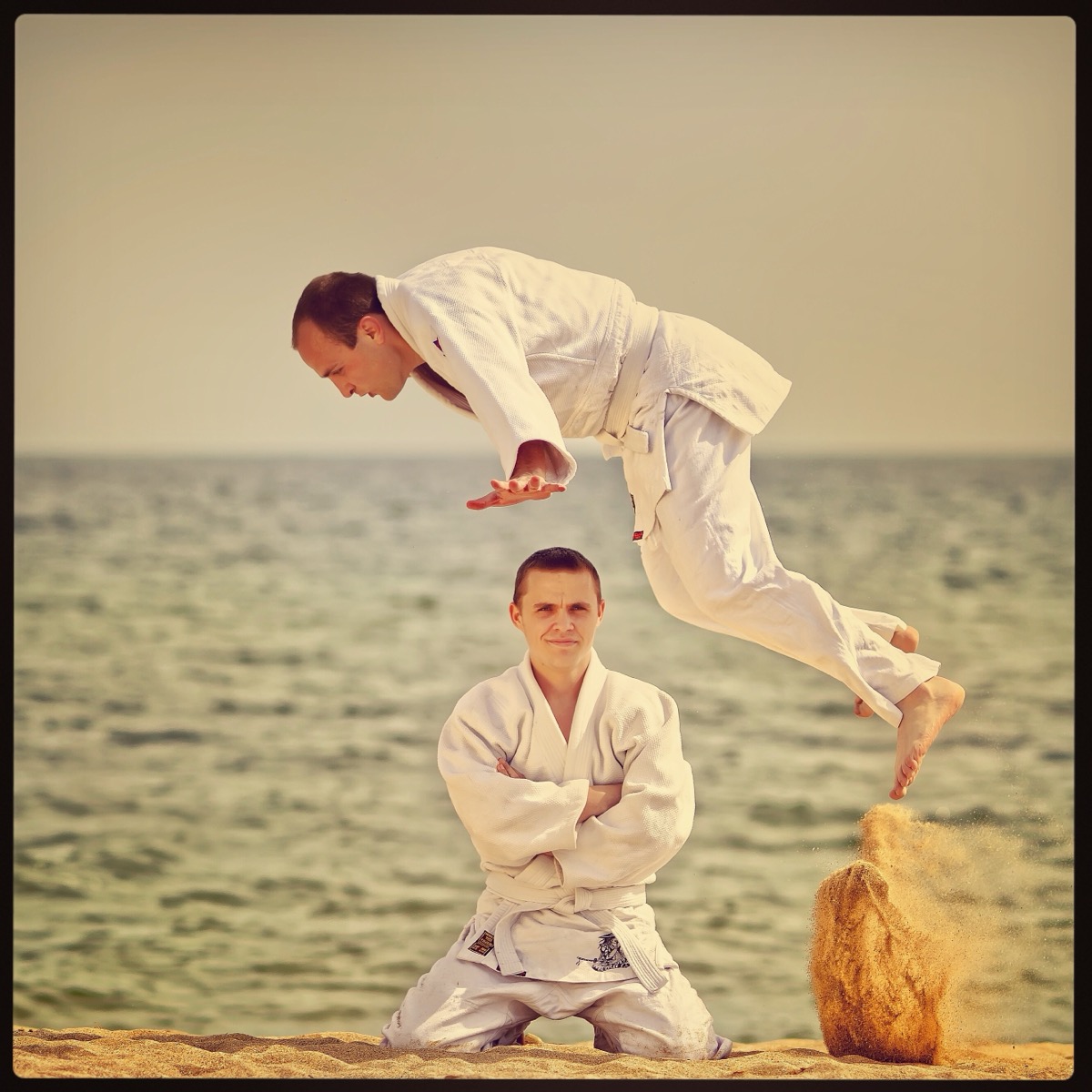
Whistle. We close. Vitalik grabs my sleeve the way he'd grabbed it for eight years — familiar grip, familiar smell of his gi, same as it was at fifteen. I move slower than usual. I know what's coming — his signature shoulder throw. I'm ready. He tries it. I hold. He looks at me. One second. First time in eight years, he's actually looking at me. And in that one second, man, I'd already won everything. The throw came after. That was just the technical part.
Final seconds of the match. Not clean, not beautiful. Simple hip throw. He drops to his side. Yuko — second from the bottom in judo scoring. One step above koka, which is landing on your backside. Yuko means landing on your side. The match continues.
Whistle. Vitalik stands up, face red, he's growling something, wants another shot, slams his fist on the mat. The judge raises my hand. I went still. The sheer fact of it. Just: "no way." I walked off the mat first.
Vitalik said nothing. Didn't congratulate me. Didn't look at me. Acted like it didn't happen — his character wouldn't allow anything else. He stayed in the sport, reached a professional level, I heard he ended up working in law enforcement. I'm certain if I found him today and asked about that match, he wouldn't remember. For him it was an episode. For me it was the point I'd been working toward for eight years and three and a half weeks.
Who are you by hunger
Twenty years later I met my own Vitalik again. Not on a mat this time. Now, when I speak and look out at a room, I see two kinds of people. Some come in, nod, take notes, promise themselves "this time everything changes." A month later they're exactly where they were. The talented ones. They have everything it takes to win. They're at the tournament the way my seven Odessa teammates were — on a vacation. Eating yogurt.
Others come in, go quiet, leave, and disappear for six months. Then they come back with numbers. Those are the ones who paid. They're not always the smartest or the most charismatic. They just knew what scale they were walking toward. Talent without work is a reserve you never opened. In the long game it doesn't hold. The talented get used to results coming easy, and when they need to push, that muscle isn't built. The person who had to fight for everything — they've got something to push with. That's the whole foundation of the PERL system — different payment modes at different levels of development.
Steve Jobs said the dots connect backwards. You can't see the meaning of a moment while it's happening. In Moscow 2003 I didn't know why I was living on an apple. Now I know. I was living on an apple so that twenty years later I could walk on stage and say one sentence.
One last thing. I still have my own Vitalik. Only now his name isn't Vitalik. His name is Igor. He's the strongest opponent I've ever faced. We step onto the mat every morning. And you — whose mat are you on today? What price are you not willing to pay right now — and that's why you're still standing exactly where you are?
People ask
What's more important — talent or persistence?
In the long game, persistence always beats talent left undeveloped. Talented people get used to results coming easily, and when they need to push harder, that muscle isn't there. The person who had to grind for everything — they've got something to push with.
How do you keep going when nothing works for years?
Understand this: you're not paying the price yet. Long-term wins don't go to the most capable — they go to whoever is willing to give up more. Every "it's not working" is a signal you haven't entered payment mode.
What does "paying the price" actually mean?
It means specific, real constraints you impose on yourself for the result: time, comfort, food, rest, entertainment. In Moscow 2003, I lived on water and bread for three and a half weeks. That was my price. Every big goal has its own.
Why do most people never reach their goals?
They show up as tourists — to look, to try, to listen. The goal goes to those who showed up to pay: to stay quiet, to say no, to redo things. Tourists are always the majority, and that's fine — the market runs on them.
What should you do when your competitors are more talented?
Nothing special. Just keep going — but honestly, not halfway. Raw talent without work gets caught by persistence in 5–8 years. That's arithmetic.

Freeman's Alliance — for those building freedom
Entrepreneurs who grow through community, not in isolation.
Learn more