21–70 Touchpoints Before a Purchase: Why "Ads Don't Work" Is the Wrong Diagnosis
After one of my events, a woman came up to me. She said she'd been following me for five years. Five years of posts, stories, reels, casually scrolling past my name — and only now did she walk up and decide. Not after my third post. Not after one webinar. Five years.
And she's the majority. The others just don't come up and tell you.
Another time, a woman approached me after a training. She'd spent two years trying to get her husband to invest in himself — to grow, to change. Two years of hitting a wall. Nothing. Then he ended up in one of my programs — and in a month, he made more progress than in those two years combined.
She was thanking me. But she had done the real work. Two years of planting seeds — conversations, her own example, ideas dropped at the right moments. The soil was ready. I just added the last ingredient.
That's what this article is about.
This Number Is 140 Years Old
People ask me where 21 or 70 touchpoints comes from. The story goes back a long way.
In 1885, London entrepreneur Thomas Smith published a book called Successful Advertising. He was the first to count: for someone to buy, you need to show them your ad about twenty times. He even mapped it out — the first time, the person doesn't notice; by the fifth, they start reading; by the tenth, they're thinking "I should try that"; by the twentieth, they buy. That's 1885. Before radio existed.
Then the Great Depression hit, and Hollywood got to work. Studios in the 1930s developed their own "Rule of Seven": for someone to show up at a box office and buy a movie ticket, they needed to hear about the film at least seven times. Seven — because the world was quiet back then: a poster, a newspaper, the radio. Attention was cheap.
In the 1980s, marketing professor Jeffrey Lant turned this into a formula: to break through to someone's consciousness and be remembered at all, you need a minimum of seven contacts over eighteen months. Not to make them buy — just to be remembered.
Then the numbers started climbing. In 2011, Google ran a large study — they surveyed thousands of buyers. The average number of sources people consulted before a purchase nearly doubled in one year: from 5.3 to 10.4. In a single year. Because everyone suddenly had a smartphone in their pocket.
The trend is obvious. 20 touchpoints in 1885. 7 when there was one radio per household. And everything shot upward the moment the internet switched on.
Today We're Counting in Dozens

Now for the modern data. In B2B, across various studies, the average cycle is around sixty touchpoints before a deal closes. In complex, high-ticket sales — over a hundred. Certain analytics platforms that track every single interaction count 88, even 266 contacts per closed deal. Gartner adds: a serious decision today isn't made by one person — it's made by a group of six to ten. And you need to reach each of them individually.
I'm not pulling this from a textbook. We've pushed a lot through our own funnels, studied competitors and peers. The conclusion is the same: today, with this level of information noise, the average cycle is around seventy touchpoints. In education and services, the actual sale can easily stretch six to nine months.
So the "Rule of Seven" that still gets repeated at every other marketing webinar — that's a number from a world that no longer exists. A world with three TV channels and a newspaper subscription.
My Clients Are Pregnancies
When I gather large audiences, I run surveys. I ask people how long they've known me. The number is consistent: the average gestation cycle for my client is about nine months.
I compare them to my children. They need to be carried, developed. For nine months, a person watches, reads, listens — and only then makes the decision to invest in learning. It's a slow movement through the levels of customer awareness — from "who are you?" to "I'm in."
This is normal. Don't be frustrated that they're "taking too long." They're gestating a decision. If you disappear in the middle of that process — your client will be born for a competitor who stayed present.
Why "Ads Don't Work" Is the Wrong Diagnosis
People come to me saying "ads don't work." They made three posts, five stories, one webinar — nobody bought. Conclusion: the niche is dead, the audience is wrong, nobody needs the product.
No. You quit at month three of the pregnancy and you're surprised nothing was born.
The first thing I explain is LTV. Even the first sale in today's market rarely breaks even. Traffic and ads cost so much that if you're counting on recovering your budget from the very first deal — you're not competitive. You'll be outrun by people who think long-term and build an out-of-competition business model.
Your client needs to keep coming back. Like their favorite grocery store. Like their go-to coffee shop. Use your services repeatedly, not just once. The first sale is an introduction. The money is in the relationship.
Marketing Is Dating

I have an analogy I use from the stage all the time.
Expecting someone to buy after one post is like expecting someone to sleep with you on the first date. Just because you asked.
That's not how it works.
First date. Then a second. Then you show up with flowers. Then you go to a movie together. You take a trip somewhere. And only after all of that — when the relationship is built — do you move in together and start building a life.
Every post, every ad, every mention, every appearance — that's another date with your potential client. They're sizing you up. Deciding if you're the right fit. Deciding whether to trust you.
You can't skip those dates and ask them to move in. But you can end them — by simply going silent.
What the Funnel Actually Looks Like
Let me show you my real numbers — not theory.
For every one paid product, we average two applications. Two people express intent — one pays. For those two applications to happen, roughly six people needed to hear the offer clearly enough to get interested. And for six to hear it — about nine people came to a presentation or webinar, some of whom didn't even stay till the end.
A standard e-commerce conversion rate is about 0.5–1%. Out of a thousand visitors, five to ten buy. Now count how many people need to see your ad to get a thousand to the page.
The problem is that most founders only look at the last number — sales. They don't see the volume of reach they need at the top of the funnel. That's why three posts feel like enough. They're not even close.
What Counts as a Touchpoint
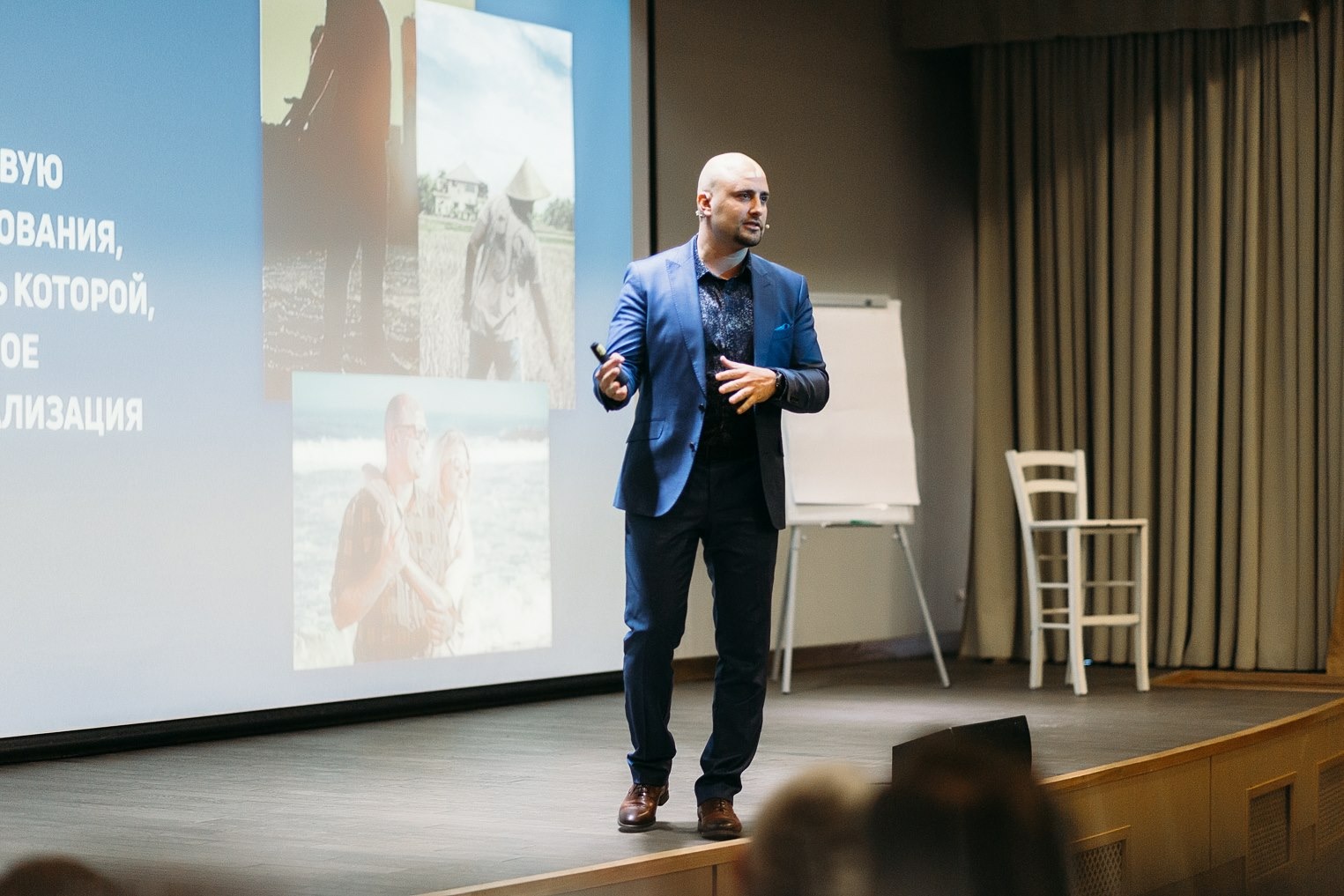
You don't have to post every day. But you need a system of contact points.
A touchpoint is anything that makes you visible. A post. A story. A reel. A paid ad. A mention from another creator, a share, a joint live stream. Your talk, your webinar, your email newsletter. Even a comment someone accidentally stumbles across under someone else's post. It doesn't matter whether it's your channel or someone else's — what matters is that the person ran into you again.
What works isn't one powerful shot. It's accumulation. The person sees you in different formats, across different channels, over and over — until your name starts surfacing in their head on its own, without effort. That's what Professor Lant meant by "breaking through to consciousness" — until you move from background noise to someone they actually remember.
But there's a condition. The accumulation only crystallizes into an image if every touchpoint reinforces the same clear message — who you are, who you're for, and why. If your niche and positioning are blurry, a hundred touchpoints won't add up to a picture. They saw you a hundred times and remember nothing. That's why before you chase reach, you need to lock down your positioning. That's exactly what my free 5-day training Point of Assembly is designed to do.
What to Do While Your Client Is "Gestating"

The biggest mistake is trying to speed up the process through pressure. Sell more aggressively, push harder, throw out discounts.
Pressure works in reverse. Trust doesn't accelerate under pressure — it collapses.
While a person is gestating their decision — give them things that make their life better right now. Without any payment. Concrete things they can apply today. Your stories — not just wins, but also how you fell. Your thinking, not just a gallery of results.
Your job is to stay present long enough and be useful enough that when someone's need finally matures, your name is the first thing that comes to mind. Not a Google search bar.
Count Your Touchpoints
Take a moment and do the math backwards.
How many sales do you need per month? Let's say ten. Applications convert at fifty percent — so you need twenty applications. A third of webinar attendees apply — so you need about seventy people in the room. And if one in twenty of those who see your announcement actually register — the announcement needs to reach fifteen hundred people.
And that's just to get ten sales from a single campaign. Most of those people won't decide from the first announcement. They'll see that you're doing another webinar, another event, another training — one, two, three times — before they ever show up for your presentation.
That's why you need massive reach at the top. To get even one sale — you need hundreds of touchpoints at the entrance. And that's perfectly normal.
If Three Posts Didn't Work
You haven't proven that advertising doesn't work. You've proven that you quit too early.
For 140 years straight — from Thomas Smith to Google — every piece of research says the same thing: people need many exposures. And with each decade, more. Advertising works. The funnel works. Just not from the first touchpoint, and almost never from the first sale.
Think in terms of nine months. Build your content as if every client needs to be carried to term. Because that's exactly what needs to happen.
Sources
- Thomas Smith, Successful Advertising, 1885 — first formulation: ~20 exposures to purchase
- Hollywood "Rule of Seven," 1930s — minimum 7 mentions for a movie ticket sale
- Professor Jeffrey Lant — 7 contacts in 18 months to break into someone's consciousness
- Google / Shopper Sciences, ZMOT Study, 2011 — sources consulted before purchase: 5.3 → 10.4 in one year
- Gartner, Pathmonk, HockeyStack — B2B touchpoint data: 60–266 contacts per closed deal
Frequently Asked
How many touchpoints does it take before someone buys?
In most modern niches: 21 to 70 touchpoints. In B2B, the average is 60+, with complex high-ticket deals exceeding 100 contacts. In education and services, the cycle typically stretches 6–9 months. The number depends on niche, product price, and the baseline level of trust in the category.
Where does the Rule of Seven in marketing come from?
Thomas Smith counted ~20 exposures in 1885. Hollywood studios developed the "Rule of Seven" in the 1930s for movie ticket sales. Professor Jeffrey Lant formalized it as a marketing framework in the 1980s. Today, thanks to the information overload, the number has grown to 21–70.
Why doesn't advertising work after just a few posts?
Because trust is built through repetition. A person needs to encounter you multiple times before they remember you — and even more before they decide to buy. Three posts is an introduction, not a campaign. Real advertising starts when you show up consistently and repeatedly in front of your audience.
What is LTV and why does it matter?
LTV (Lifetime Value) is the total revenue a customer generates over the entire relationship. The cost of acquiring a customer today is so high that the first sale rarely covers it. The real money is in repeat purchases and long-term relationships. That's why chasing discounts to force a first sale is a losing strategy.
What counts as a touchpoint?
Any contact between a person and your brand: a post, story, reel, paid ad, live talk, mention by another creator, webinar, email, or comment someone stumbles across. What matters isn't the platform — it's consistency and accumulation. The person needs to see you across different formats and channels, again and again.

"Point of Assembly": Build Your Positioning in a Week
Touchpoints only hit their target when people understand who you are from the very first encounter. In this free 5-day intensive, you'll build your niche, offer, and positioning — with me and Alexander Turubarov. So every touchpoint works instead of disappearing into noise.
Join Free