The Day My Father Cried. It Took Me My Whole Adult Life to Give Myself the Same Permission
I stood by the front door for a good twenty minutes, my back pressed against the hallway wall, listening for whether the lock on the landing was about to turn. I held my school bag with both hands in front of me, a D grade sitting inside my report card, and I kept whispering a prayer under my breath, please let him stay late at work tonight. My father was a military man, and he raised me under near-military rules: a D grade, a dropped fork, taking too long to come when called, any of it earned punishment, sometimes deserved, sometimes just because he was in a mood. His entire philosophy fit into one sentence, and he said it exactly like that: "As long as it hurts, you'll remember."
One time he went too far. I won't describe exactly what happened, that's not something to trade for a good story. I'll just say the pain in that moment was bad enough that he saw it in my eyes, and something in him broke. I was sitting in the corner, my back against the wall, and I suddenly saw tears running down his face. He asked me to sit next to him, pulled me into his chest, and told me he loved me and that he was sorry. I cried harder than I had from the pain itself.
That was the only time I ever saw him cry.
He always let me cry, though. During Armageddon, the Bruce Willis movie, I sobbed openly, and he'd say, "Cry. It means you have a big heart." Thank you for those words, I still remember them. But that rule somehow never applied to himself. Real men don't cry, that's how his worldview was built, and he lived inside it with total consistency.
Giving myself that same permission took my entire adult life, three businesses, thousands of students, and one conversation with myself last December that I'll get to below. The rule my father never once said out loud, but showed me exactly once, shaped how I built companies, how I ran a team, and how I nearly broke myself trying to stay strong for thousands of people at the same time.
The Rule Nobody Says Out Loud
Kids don't read instructions, they read behavior. Out loud, my father told me the exact opposite of what he showed me by example. And a child's mind does the simple math: weakness is dangerous, you can't be the first to show it, or you'll be punished. Once in his life, my father showed me a different option too, that tears can be followed by an embrace instead of punishment. But one exception against years of a running system gets filed away as an exception, not a rule.
I grew up a closed-off teenager, without much confidence and without opinions I was ready to defend out loud. At sixteen, it hit me that this couldn't continue, and at seventeen I threw myself into what I'd now call self-esteem work: if there's no foundation inside you, you build one outside, through results nobody can argue with. I tried to strike first, to be the loudest, most visible person in any room, because I needed physical proof that I was worth something at all. By twenty-two, that got me my first million, before my classmates even finished their degrees. From the outside, it looked like confidence. From the inside, it was a man running from the fear of stopping and discovering that without a result, he was nothing.
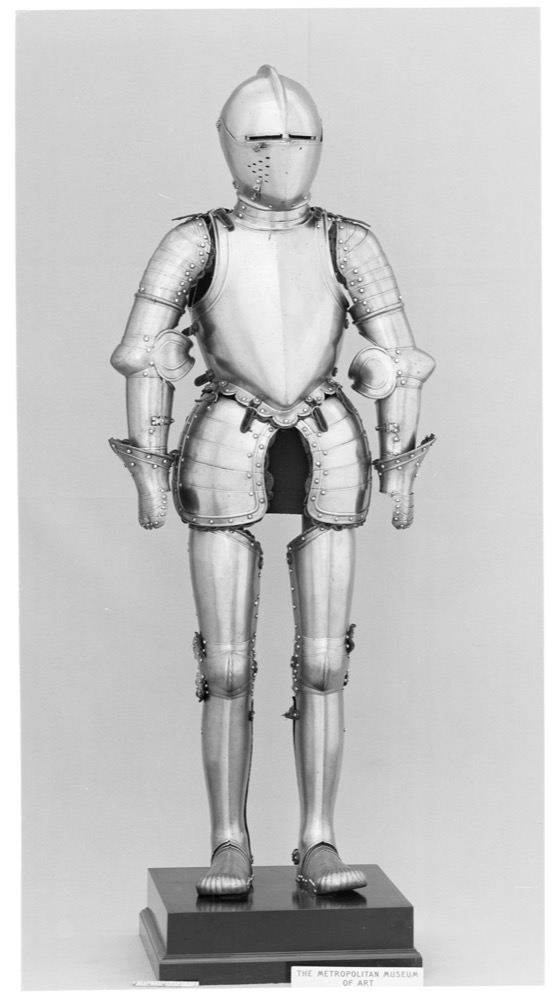 ITALY · CA. 1570
The First Million That Proved Nothing
Proof doesn't work like savings. Every new result closed the internal question for a while, and then the question came back, louder. I built one business, then another, gathered hundreds and then thousands of people around me who called me their mentor, and the whole time, the same hallway math from childhood kept running underneath, except the audience now played the role my father used to play. I couldn't get tired, couldn't admit I didn't know something, couldn't tell my team "I'm struggling right now," because by hallway logic, a leader who admits to struggling stops being a leader.
Armor Doesn't Care Where the Threat Is Coming From
Someone here will say: what's wrong with that, didn't discipline get you the result? Fair question, and discipline absolutely got me the result, I won't argue that for a second. The problem isn't discipline. The problem is that the armor that helps you sprint to your first million starts getting in the way right around where the race for proof ends and the work with real people begins, your team, your clients, your kids. I covered a similar mechanism in a piece about how it wasn't failure that nearly broke me, it was the image of a man who always had everything under control. Armor doesn't distinguish where the threat is coming from, it reacts to any vulnerability the same way: hide it, smile, say "everything's fine."
Last December, I felt this up close, because of my own community. I had a real conflict with one of the members of a private group I run. Two months in the community, never stayed on a single call to the end, never finished a single assignment, never opened a single book from the list, and then she wrote to me: "I see other people getting results. I don't have mine. So you didn't keep your promise." And that's when it actually broke me. Not because of that one message, but because a month earlier I had removed five people from the community. I expected it, and it still hurt, because I don't treat people like users of a service, I actually invest in each one. I sat there and cried over one community, while, in the same room, twenty-eight people made more than a million rubles combined in their first week.
My first instinct was that same hallway math: hide it, don't show it, make a joke. But this time I wrote about it publicly, out loud, including the part where I was embarrassed that one person had thrown me off balance. My armor had spent my whole life promising to protect me from exposure. The moment I took it off, even for one post, there was nothing left to expose, just a tired man who had every right to be tired.
Technology to Apply: Four Questions Against Armor
Over years of consulting, I built a short test I use to tell real resilience apart from trained armor. I ask it of myself and of clients whenever I see the classic picture: someone carrying a business, a team, a family, and hasn't admitted to a single person in a quarter that it's hard.
- Who in your life can you tell "I'm not okay right now" without rehearsing the sentence first? If the answer is "no one," or "my partner, but I prepare the phrase in advance," the armor is already making decisions for you.
- When did you last ask for help before a situation turned critical, not after? Asking after the fact means the armor is already in its terminal stage, you waited until it got bad enough to earn the right to ask.
- How many decisions did you make last month to avoid looking weak, rather than because it was the best call? The honest answer here is almost always unpleasant and almost always accurate.
- If the result disappeared tomorrow, what would be left of your self-worth? If the answer is "nothing," that's a warning sign, the business has quietly turned into proof you have to keep re-earning every single week.
None of these questions solves anything in a single conversation with yourself. But each one peels back a layer of armor, and that's usually enough to see the person underneath it, often for the first time in years.
The Door I No Longer Have to Stand at for Twenty Minutes
In 2016, when my daughter was still tiny, I wrote a line on my blog that I didn't take too seriously at the time: kids are our projection, our best qualities, and a parent's only job is not to ruin it, to let them find their own path, to be a mentor instead of a father, an example instead of a teacher. Back then I meant it as a nice thought. Today, after years of business, teams, and failures, I understand it far more literally. I later wrote in more depth about how a parent's beliefs quietly become a child's beliefs at the dinner table, without a single lesson ever spoken out loud.
My father cried in front of me exactly once in his life, and that single time is when I felt closer to him than in all the years of his flawless composure combined. He didn't mean to teach me that on purpose, if anything, his entire philosophy taught the opposite. But it's the one lesson from my childhood that I try today, consciously, to repeat, instead of catching a single glimpse of it once and letting it go.
I still remember those twenty minutes by the wall in the hallway, the weight of the bag in my hands, the sound of the lock I was so afraid to hear. I don't want my daughter to read those twenty minutes as a calculation about weakness. I want the door, the one I now stand on the other side of, to always open easily, even if there's a bad grade in the bag. I am the door now. And I've decided that anyone can walk through it, even exhausted.
Frequently Asked Questions
Why are strong leaders afraid to show weakness?
Because at some point, in childhood or early in their career, that rule saved them from pain once, weakness got punished, strength got protected. The mind records that calculation once and then runs it automatically, even long after circumstances have changed and the person who used to punish them is gone.
What's the difference between emotional armor and healthy resilience?
Resilience absorbs pressure and recovers. Armor doesn't recover, it simply doesn't let anything in, threats or support alike. The test is simple: can you tell someone close to you "I'm not okay" without rehearsing the sentence first. If not, that's armor, not resilience.
Isn't it risky for a leader to show the team they're struggling?
It's riskier to hide it for years and then snap over nothing. One honest moment of visible struggle, shown rarely, usually brings a team closer to its leader than months of pretending everything is under control.
How do you know a decision comes from armor rather than good judgment?
Ask yourself directly: am I doing this because it's better for the business, or because otherwise I'll look weak to someone. The honest answer to that question is almost always immediately visible, uncomfortable, but accurate.
Where do you start if the armor has been a habit for years?
Not with a big confession to the whole team at once, start with one person close to you, a partner, a friend, a therapist, someone you can tell the truth to without rehearsing it first. It gets easier every time after that.

Choose your next step
5-day game for experts — from zero to first $1,500
Start free →5 days — how to use AI in practice as an expert and entrepreneur
Learn more →Practical program: from chaos to a managed client flow and stable income
Learn more →Closed international community — the environment where scale becomes a habit
Apply →Tired of being strong for everyone, all the time?
Join a community that works through business models and the armor that gets in the way of running them.
Learn more